

“With micro-credentials, we strengthen the social role of the university and consolidate lifelong learning as an accessible tool for everyone” 5 December 2025
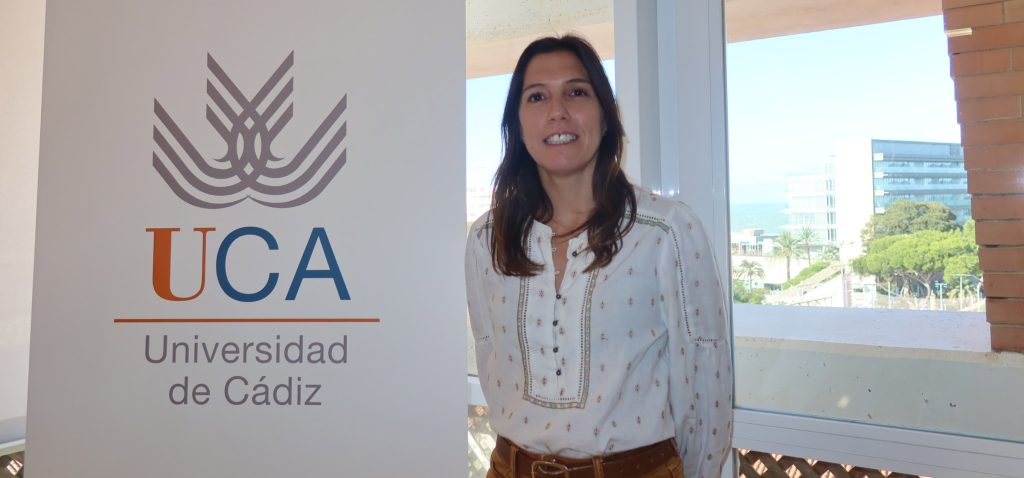
María de Andrés, Director General for International Degrees and Continuing Education, highlights the UCA’s role within academic networks across different region
The university is like a bicycle: if it does not move forward, it is destined either to fall or, in this case, to wither until it disappears. Even more so in an increasingly competitive environment, where higher education must face challenges that were unthinkable barely a decade ago. Among them is the adaptation to common teaching frameworks designed to transform the transnational space—particularly within Europe—into a vast shared campus. A place where curricular and teaching projects flow across borders and where mobility becomes the rule rather than the exception. Equally crucial is the development of strategies that integrate the university within the broader learning ecosystem of society, especially among groups that traditionally remain outside the academic sphere. These two areas shape the daily work of María de Andrés, Director General for International Degrees and Continuing Education at the University of Cádiz. In this interview, she analyses how the UCA is adapting to new trends in the internationalisation of education and the role of micro-credentials in the present and future of the institution.
Your Directorate brings together two strategic areas: international degrees and continuing education. How have they contributed to transforming the University of Cádiz’s academic model in recent years?
The integration of international degrees and continuing education has enabled the University of Cádiz to move towards a more flexible and global academic model, aligned with current social and labour needs. In the field of international degrees, we have strengthened the internationalisation of our academic offer, particularly through joint degrees within the SEA-EU alliance and double-degree agreements, mainly with Latin American universities. This has enhanced the UCA’s presence in international academic networks and its positioning within the European Higher Education Area.
Regarding continuing education, we are consolidating a strategic axis that connects the university with its socioeconomic environment through an expanding offer of micro-credentials focused on professional upskilling and reskilling. These programmes respond to labour-market demands and to the challenges associated with digitalisation and sustainability.
In an increasingly interconnected university landscape, how is your Directorate—attached to the Vice-Rectorate for Degrees and Quality—coordinated with other areas and vice-rectorates of the UCA?
The key to our work lies in close coordination across the university. In the field of international degrees, we work hand in hand with the Vice-Rectorate for Internationalisation. From the development of joint degrees to new Erasmus Mundus proposals, our work is fully aligned.
In continuing education, the Vice-Rectorate for Entrepreneurship and Employability and the Communication and Marketing Office play fundamental roles. Their collaboration helps us strengthen ties with companies, promote lifelong-learning initiatives and ensure effective knowledge transfer to society.
This academic year opened with the launch of the new Blue Economy degree, linked to international degree development. What role do strategic alliances—such as SEA-EU—play in promoting initiatives of this kind?
The SEA-EU alliance has been decisive in the development of international joint degrees. A flagship example is the joint degree in Blue Economy (SeaBluE), the first in Spain coordinated by a Spanish university within a European alliance. It is a programme designed collaboratively from scratch by all participating universities. Although a joint degree can be developed outside an alliance, the governance and management framework provided by an alliance—in our case SEA-EU—creates a solid, shared and operational foundation that greatly facilitates these processes.
The UCA has recently taken part in the UEUE Forum, dedicated to analysing the present and future of international degrees. In your view, what trends are Spanish universities following in this field?
Spanish universities are moving decisively towards international degree implementation, whether through double degrees or joint programmes. Within the UEUE Forum, universities integrated into European alliances are focusing on the development of the European Degree.
The current trend is to adapt existing international degrees so they may qualify for the future European Degree Label, a quality seal promoted by the European Union to recognise programmes that meet shared standards in governance, mobility, co-designed curricula and quality assurance. Its goal is to facilitate mutual recognition between countries, enhance employability and strengthen European identity in higher education. In our case, the joint degrees developed within SEA-EU already meet EU criteria, placing us in a very favourable position for obtaining this distinction.
What are the main differences between an international degree and a conventional programme in the Spanish university system?
The first difference lies in accreditation processes. In joint degrees across European universities that follow the European Approach, evaluation is carried out by the quality agency of the coordinating university, and that accreditation is automatically recognised by agencies of all partner universities. In double degrees, the UCA degree is accredited through the national system, complemented by a specific agreement with the partner university outlining the particularities of the programme. International degrees also include mandatory mobility and may incorporate differentiated access mechanisms, as is the case with the current international joint programmes.
Micro-credentials have become a key tool within continuing education. How do you assess the development of the UCA’s programme in these first months?
Micro-credentials are an effective way to transfer specific competencies to society. For the UCA, having a strong micro-credential plan is essential to give visibility and value to this type of training. The reception has been very positive. Some micro-credentials will launch their third edition this year due to high demand. We have also achieved a broad and diverse offer spanning social sciences, medicine and engineering. The coming year will be crucial to consolidating the plan and establishing micro-credentials as the main short-term continuing-education pathway within the institution.
How have businesses and external organisations responded to the training proposals developed through micro-credentials?
The response has been extremely positive. Eighty percent of the micro-credentials developed or underway involve the participation of companies or external entities, demonstrating strong interest in this format. Collaboration takes many forms—from identifying training needs to co-teaching programmes or co-financing. A wide variety of organisations take part, including public institutions such as the Andalusian Health Service, as well as large companies and SMEs.
One of the core principles of the LOSU is the social reach of university education. What strategies is your Directorate implementing to extend the UCA’s training offer beyond the university community?
A key objective of our own degrees—and especially of micro-credentials—is to reach people who are not part of the university community. This is a major challenge because it requires engaging new audiences with diverse profiles, needs and communication channels. To address it, we are implementing several strategies.
First, we are strengthening collaboration with professional associations and the Confederation of Entrepreneurs, with whom we hold regular meetings. These organisations help identify real training needs and also act as prescribers, sharing our micro-credentials with their members and associated companies.
In parallel, we work closely with the UCA’s Communication Office to broaden our social impact. This includes producing targeted materials for social media, developing information campaigns and collaborating with media outlets to bring our training offer to the wider public.
Through these actions, we are reaching specific professional groups as well as broader audiences, contributing to the university’s social mission and consolidating lifelong learning as an accessible tool for all.