

“University sport will be what best serves the interests of the students” 21 November 2025
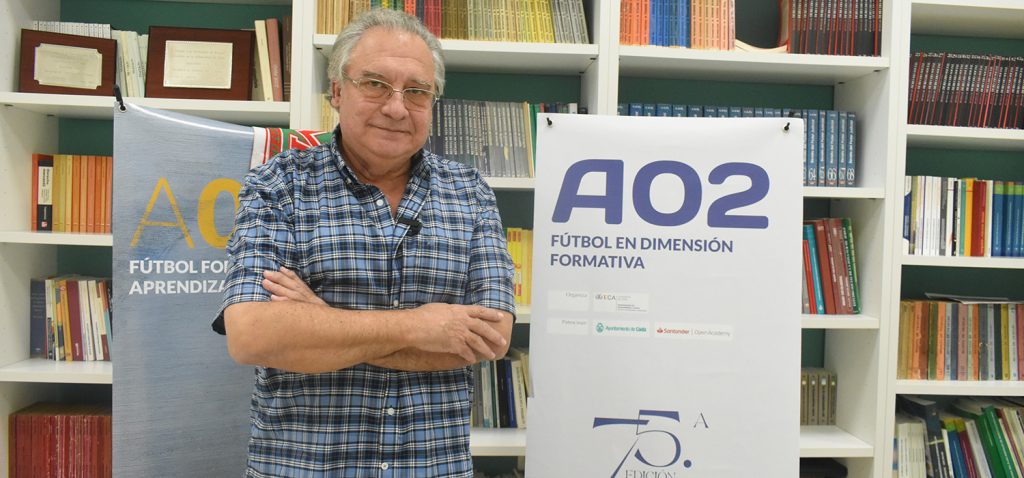
DAVID ALMORZA | Secretary Director of the Sports Department
port is synonymous with physical and mental health. It is also a school of life that fosters values such as personal improvement, discipline and cooperation. Promoting sport among the university community so that academic life is balanced with sport, study and leisure is the way to educate through an integral and high‑quality education.
Sport also offers the opportunity to break barriers and glass ceilings; it is a potential engine of change. The Sports Department of the University of Cádiz coordinates and manages its own and partnership activities and courses, internal and external competitions, and its sports facilities.
David Almorza, Secretary Director of the Sports Department of the University of Cádiz, outlines in this interview how the relationship between sport and the UCA works.
What are the main lines of action of the Sports Department currently?
Since we took over the direction of the Sports Department we have been clear that the objective of sport at the University is to contribute to the training of students. There is no other objective. Bear in mind that the University and teaching centres are the only institutions that have sports courts, their own sports infrastructure. Why? Because it is part of the training of their students. No other institution, no other organisation, has those facilities. In fact, the Student Statute states that physical activity is part of the students’ integral education, and that is clear to us. From there, with that as a priority axis, we built strategic axes within what the Sports Department is: equality and values education, sustainability, new technologies, internationalisation, health and wellbeing, and also social responsibility. And with those six axes, having training as the main axis, that is how we are working.
What role does sport play in the integral education of university students? How does sport contribute to student wellbeing and mental health?
Sporting discipline and academic discipline have always been similar. Academic discipline requires a period of study, preparation for an exam. Sports discipline requires a period of training and preparation for a competition. At their base, discipline is the same. With training as the fundamental axis, what we have done is build a programme we have called UCA Sport. It is a comprehensive programme where there is a very wide training offer. Just this month of November there are about ten training courses, all free, which students can take. Some are online, others face‑to‑face. This month we’ve had the football referee course, a rowing day, a session on football coaches, on sport psychology, on triathlon, on flag football; a number of courses that some have been held in collaboration with the Andalusian Sports Institute.
Many times sport has been simply associated with physical activities. But now that addressing mental health is so fashionable, it must be clear that sports activities also help to release tension, to prepare for things beyond the purely physical; they help guarantee that mental health…
Of course, because truly health is the concept that integrates physical health and mental health. Being good for physical health, sport is also beneficial for mental health and the person’s stability, of course.
How do you perceive student response to the proposed activities?
This year has been the year in which the highest number of sports cards have been generated in the entire history of the University of Cádiz. It has been the year with the greatest student participation. When the current rector, Casimiro Mantell, arrived, it was implemented that the sports card would be free. That helped a lot, but in addition a series of activities were generated to accompany it. That has resulted in all that initial attraction and the ability to attend sports activities for free have combined and become the explosion we’ve had and are having. On many occasions we’ve had to say “no more people” at this time, in this gym, because we were full of users. So I believe the entire train‑sport plan associated with the card activity has had a very beneficial impact on students.
And if we extend the university community a bit, does university staff also join the sports offer?
Yes, obviously; the whole university community has that facility. Whether we like it or not, university teachers know that our training is continuous. So there are professors who are participating in training offers we are giving or are simply trying new sports or learning other techniques, and the administration staff are also attending what we are offering.
Earlier we spoke of joint training with the Andalusian Sports Institute. Normally one says that the University must be connected with its surroundings. What is the University’s relationship with various administrations and entities that can help in sports matters?
Well, our relationship with the surroundings has been continuous. Since the University exists, it has related with all its surroundings. Our facilities are, of course, open to society. Our collaboration with town councils is very frequent. Now with the university championships of beach volleyball, sailing and surfing, the collaboration with the Provincial Council, with the Cádiz Town Council, with Vejer and El Puerto de Santa María, is present. Our collaboration with Villamartín on fair play; with Chiclana, with San Fernando, that is to say, we are always doing things with town councils. With federations too. We work with federations so that our students obtain that certified title free of charge. Next week we start the football referee certificate, which will be free for students and for the university community who want to obtain it. And then with clubs and gyms we have collaboration, because they complement the University’s sporting offer in places where we cannot attend. That is, in the towns of the province where we do not have facilities, we have agreements with gyms and clubs from which the university community can benefit and practice sport.
UCA has the peculiarity of having four campuses. How would you rate the level of sports facilities?
The strategic location of the University of Cádiz is on four campuses, and that generates additional economic costs compared with a university that has a single campus. A university with a single campus will have sports facilities, a library, centralised services; when we have four, the problems begin. But well, that was the University’s design, it is not something I am criticising now, but I do highlight the difficulty. We only have our own sports facilities on the Puerto Real campus and the Jerez campus. Facilities would need to be completed, when possible, in the municipalities of Cádiz and Algeciras. The truth is that the sports technical staff are doing very good work. They are working above their demands and what is asked of them and they are doing an important job to accommodate all the user influx we are having.
Earlier we discussed the relationship with students, the need for their involvement. Now you are going to launch, in collaboration with the CEUCA, the I UCA CUP, an initiative covering up to nine disciplines. What will this entail?
The fact that the CEUCA has already adopted a sports section within its structure as student representation is already an indicator of the importance sport is having among the students of the University of Cádiz. And our collaboration with them is necessary for the institution as a university, since those who really determine certain paths in the institution must be the students. As to the collaboration with the students, we already helped in organising the Copa Gallo and now they want to extend that model across the four campuses. Of course, we are working with them. It is an ambitious project that would involve nine sports disciplines across four campuses. If the students are enthusiastic and we are fully willing to give support, then it will go ahead.
And speaking of sports disciplines, at UCA one can practice everything from individual sports like swimming, chess or taekwondo to team sports like football or basketball; there is even an area dedicated to water sports…
Within what is the university community, obviously football—not only at university, but globally—is a very media sport in all its varieties. But our offer must reach everyone. Therefore, we must not only do more media sports, but other types of activities too. We are clear that competition is good, but not all students want competitive sport. Then we aim for other types of sports practice and we offer it. Where are we heading as a university? Well, really to the sport that they are looking for. How do they benefit? If we provide different disciplines or different things where they can try a new sport – we’ve done boomerang workshops, slingshot workshops… – and they participate, they can try different sports. And that is good.
Regarding the nautical campus, the Sports Department on one side and the nautical campus on the other, since it is not integrated into the Sports Department. There is an objective of integration in the future. However, as current safety conditions stand—recording this interview at a time when a yellow alert is in effect and everything that implies—we are clear that nautical activities must have a strong safety guarantee. Likewise, in terms of the university’s objective, since we have discussed values: when students go looking for a job, the fact of having engaged in sport at a certain level is increasingly valued. Because that, having done sport activity at a certain level, is associated with the person having a set of values, team‑work strategies, behaviours that are useful for companies today. Ultimately, that sports education we are giving at all levels will serve for the employability of our students.
We have also spoken of sport’s cross‑cutting dimension, though, many times—even at the educational level—physical education continues to be associated with ‘less serious’ subjects…
Yes, sporting activity is gaining greater importance. And I believe that, at the university level, the sports that will be played and the path of that practice will be defined by the students.
UCA offers both non-competitive and competitive sports. How would you assess the university’s participation in the Andalusian University Championships and other competitions?
Well, there are Andalusian university championships, there are Spanish championships, but competition is just one part of education. It’s not the whole of it, nor even the main part, but it is still part of the student experience. We understand that taking part in these university championships is an educational activity. But we don’t measure participation by sporting achievements; for us, the most important thing is how many students take part. Yes, a minimum level of performance is needed to participate, but competitive results depend on many other factors. For us, improvement means increasing both the number of sports disciplines and the number of students who get to participate. We compete to learn, rather than just to win.
In countries like the USA, the sport-university connection opens doors for personal and professional development. Within the European context —and more specifically at UCA— is there any similarity with this Anglo-American model? How are student athletes supported, particularly those competing or practising elite-level sports?
The U.S. model is not transferable to Europe, nor to European or Spanish universities. They have other systems that provide financial resources that we simply don’t have access to. That said, we do have students who practise sport and compete at a high level — these are our top-level athletes. We also have students classified as high-performance athletes. These students consider certain universities and degree programmes based on how compatible they are with their athletic careers. From the beginning, we introduced a system to support these students, helping them balance training and competition with their academic responsibilities. Each of them is assigned a tutor within their degree programme to help them manage class attendance, practical work and exams alongside their sports commitments. Since launching this system, we’ve seen a noticeable increase in the number of high-level and high-performance athletes at UCA — in fact, the number has doubled. The fact that UCA is known for supporting student athletes is drawing more of them to us, and that’s positive. They’re our students, and many of them also get involved in the broader sports activities we organise.
In the age of artificial intelligence, what role do you think technology and digitalisation can play in managing, promoting and practising sport at university?
Artificial intelligence is here to stay. I think its role in sport is only going to become bigger and more influential. It could become a kind of 24/7 personal coach. But I also think that’s a limitation — it will never replace a real coach, a human being who trains and connects with another person, someone with the skills that we teach in our degree programmes in Physical Activity and Sports Science, in Physiotherapy, and others we offer at the university.
How do you see the future of sport at UCA in the short and medium term? And finally, what message would you like to share with the university community — both those already involved in sport and those who haven’t yet taken that step?
It hasn’t been long since university sport really started to gain traction. When I started as vice-rector, the traditional INEF model still existed. That later evolved, and now sport is integrated into many university degree programmes across Spain. There is a growing social interest in sport, and that’s both positive and important. The current paradigm is spreading, and I believe that the future of university sport will go in the direction students choose — towards what benefits them, because they know their needs, and they know what will be expected of them when they enter the job market. They know how sport helps them in their daily lives and how it makes them feel better. So, it’s essential that we listen to students and understand what they need or how we can adapt sport activities to support them. At the Sports Department, we regularly communicate what we’re doing through internal channels and the UCA website, and the feedback is increasingly positive. Students respond, share their views, make suggestions, and whenever we implement something they’ve proposed, it’s always a success.
As for a message to the university community: to those already involved, thank you for being there and taking part. And to everyone else — come and see what we’re doing. Explore what this university is doing for sport. This investment — not financial, because we don’t have a big budget — but in time, dedication and enthusiasm, is already producing great results in the Sports Department.