

University of Cádiz Uses Drone-Based LiDAR Technology to Advance Research at the Phoenician Site of Castillo de Doña Blanca 25 May 2026
The European PHOENIX-UASL project, led by researcher Antonio Pecci, aims to detect hidden structures and provide a new perspective on the archaeological landscape
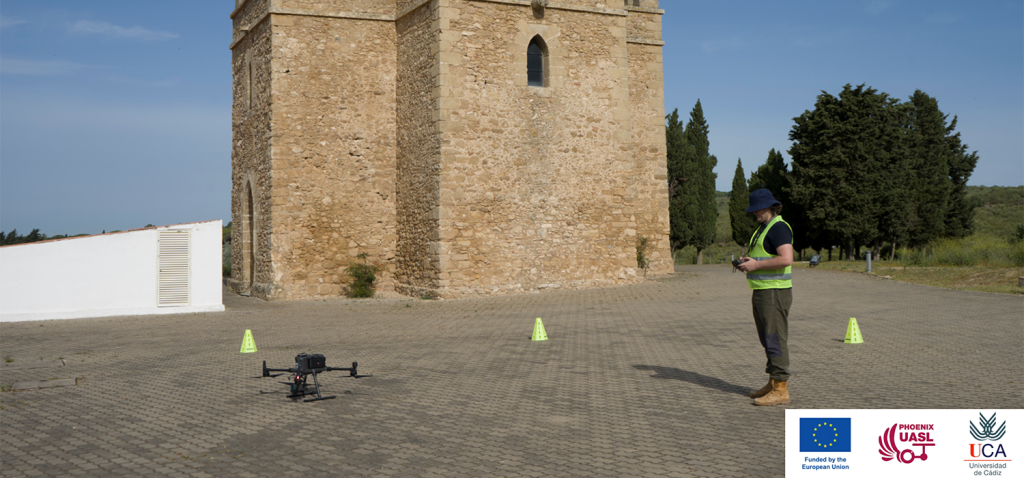
Researchers at the University of Cádiz are carrying out an innovative archaeological survey campaign around the Castillo de Doña Blanca site using LiDAR technology mounted on drones, a tool capable of generating high-resolution terrain images and advancing knowledge of one of the most important Phoenician enclaves in the western Mediterranean.
The work is being developed within the framework of the European project PHOENIX-UASL, funded through the Marie Skłodowska-Curie programme of the European Union and led by researcher Antonio Pecci, recipient of a postdoctoral fellowship under the supervision of Professor of Prehistory Ana María Niveau-de-Villedary y Mariñas, director of the PHOENIX MEDITERRANEA research group (HUM-509) at the University of Cádiz.
The campaign focuses both on the archaeological site itself and its surrounding environment, with the aim of obtaining an unprecedented overview of the territory that may allow researchers to identify archaeological structures hidden beneath vegetation or sediment. The project also seeks to analyse the organisation of the settlement’s defensive system and urban layout.
The use of LiDAR sensors mounted on drones represents a significant advance in archaeological research because it enables the generation of digital terrain models with centimetre-level resolution, capable of revealing microtopographic details that are imperceptible through traditional survey methods. This approach opens new possibilities for the study of archaeological landscapes and complements conventional excavation and analysis techniques.
Beyond the technological component, the PHOENIX-UASL project also aims to evaluate the potential of drone-based LiDAR systems in archaeological contexts by establishing working protocols and methodologies that may be replicated in future research projects. Alongside this methodological dimension, the initiative integrates archaeological, environmental and geospatial data to reconstruct the historical evolution of settlements from Prehistory to the Early Middle Ages.
For the execution of the drone flights, the project relies on the collaboration of the University of Cádiz Drone Service, a specialised unit integrated within the University Institute for Marine Research (INMAR). The service operates advanced equipment and holds certification from the Spanish Aviation Safety Agency, ensuring that the work is carried out according to the required technical and safety standards.
Located in El Puerto de Santa María, the Castillo de Doña Blanca is considered one of the most significant Phoenician archaeological sites in the western Mediterranean. Its relevance lies in its historical role as a port and commercial centre between the eighth and third centuries BC, as well as in the preservation of urban, defensive and funerary structures that make it a key site for understanding Phoenician presence in the Iberian Peninsula.
The University of Cádiz resumed systematic excavations at the site in 2024 after more than two decades without major archaeological interventions. Since then, researchers have launched a new phase of investigation that combines traditional fieldwork with advanced technologies such as LiDAR, georeferenced photogrammetry, GIS analysis and digital reconstruction tools.
Recent campaigns have already contributed to revising previous interpretations of the site’s Punic-Hellenistic defensive system, allowing researchers to identify structures linked to active military defence, including postern gates, artillery towers and guard facilities. These findings have reinforced the hypothesis that Castillo de Doña Blanca functioned as a highly organised military fortress during its final historical phase, closely connected to the growing influence of Carthage in southern Iberia.
The new LiDAR survey is expected to provide a more precise diagnosis of the current condition of the archaeological enclave and to support the planning of future interventions. The results will also serve as the basis for the future General Research Project “Castillo de Doña Blanca”, currently under application before the Regional Government of Andalusia, which aims to deepen the study of the site’s urban organisation, defensive structures and territorial connectivity