

University of Cádiz Strengthens Its Presence in the Asia-Pacific Region with an Institutional Mission to China 6 March 2026
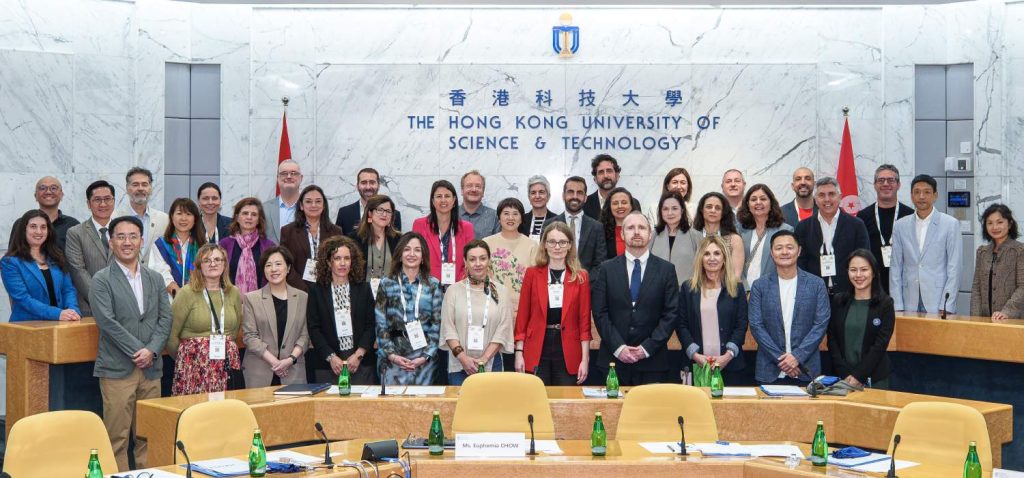
Vice-Rector for Internationalisation Marcela Iglesias attended the annual Asia-Pacific Association for International Education (APAIE) conference and held meetings with representatives from around twenty universities.
The University of Cádiz (UCA) carried out an institutional mission to China between 23 February and 2 March, as part of its internationalisation strategy, with particular focus on the Asia-Pacific region as a strategic geographical area. The UCA delegation was composed of Vice-Rector for Internationalisation Marcela Iglesias and Director General for the Promotion of Internationalisation Sofía Pérez de Guzmán.
The mission coincided with the annual conference of the Asia-Pacific Association for International Education (APAIE), held in Hong Kong from 23 to 26 February 2026, an event that brings together universities from around the world. UCA took part as part of the Spanish university delegation at the Study in Spain stand, coordinated by the Spanish Service for the Internationalisation of Education (SEPIE).
During the conference, the University of Cádiz delegation held meetings with representatives from 18 universities, including both existing partners and potential new collaborators from several countries. These included Universidad Adolfo Ibáñez (Chile), Xi’an Jiaotong-Liverpool University (China), ISEM OUEST (France), Universitas Indonesia (Indonesia), Soka University (Japan), Tecnológico de Monterrey (Mexico), and Vanlang University (Vietnam).
Meetings were also held with representatives from nine Turkish universities—Anadolu University, Anurag University, Atatürk University, Bayburt University, Bolu Abant İzzet Baysal University, Çukurova University, Dicle University, İstanbul Gelişim University, and Ondokuz Mayıs University—as well as with partner institutions from the SEA-EU university alliance, specifically Ulsan National Institute of Science and Technology (UNIST) and Nord University.
These meetings identified shared interests in academic mobility and exchange, including participation in the Erasmus+ Programme, Blended Intensive Programmes (BIP), Capacity Building projects, Staff Weeks, and visiting researcher programmes. The UCA delegation also promoted its academic offer at undergraduate and postgraduate levels, available in both Spanish and English, with particular emphasis on the Joint Programmes of the SEA-EU alliance.
In addition, the University presented its International Summer School and the intensive Spanish language courses offered by the Centre for Modern Languages (CSLM).
During the conference, the Consul General of Spain in Hong Kong, Miguel Aguirre de Cárcer García del Arenal, visited the Study in Spain stand and met with members of the Spanish university delegation.
Visits to four Chinese universities
The institutional agenda continued with visits to four universities in Hong Kong, Macau and Beijing, as part of the Spanish university delegation coordinated by SEPIE.
On 26 February, the delegation visited The Hong Kong University of Science and Technology (HKUST). The following day, 27 February, meetings were held at the Macau University of Science and Technology (MUST). The mission concluded in Beijing on 1 March with visits to Tsinghua University and Beijing Jiaotong University.
At each institution, working meetings were held with university representatives, during which the delegations presented their institutions, research priorities and teaching programmes, as well as their interests in future collaboration. The parties agreed to explore the signing of cooperation agreements aimed at developing joint academic and research activities.
In addition, bilateral meetings were held with faculty members from the Departments of Spanish Language and Literature at Shenzhen University (26 February) and Peking University (28 February).
Meetings with Spanish institutions in China
The institutional mission also included meetings at the Embassy of Spain in China. On 1 March, the delegation met with the Spanish Ambassador to China, Marta Betanzos Roig, where representatives of Spanish universities shared their impressions following the institutional visits and discussed potential avenues for cooperation with Chinese institutions.
On the same day, the delegation also held a meeting with María Luisa Ochoa, Education Counsellor at the Spanish Embassy in Beijing, and Adrián Gutiérrez Árboles, counsellor at the Centre for the Development of Industrial Technology (CDTI). The meeting focused on existing areas of collaboration between Spanish and Chinese higher education institutions, as well as government funding programmes available to support joint initiatives.