

University of Cádiz Opens the International Seminar ‘Copla in Exile / The Exile of Copla’ 25 May 2026
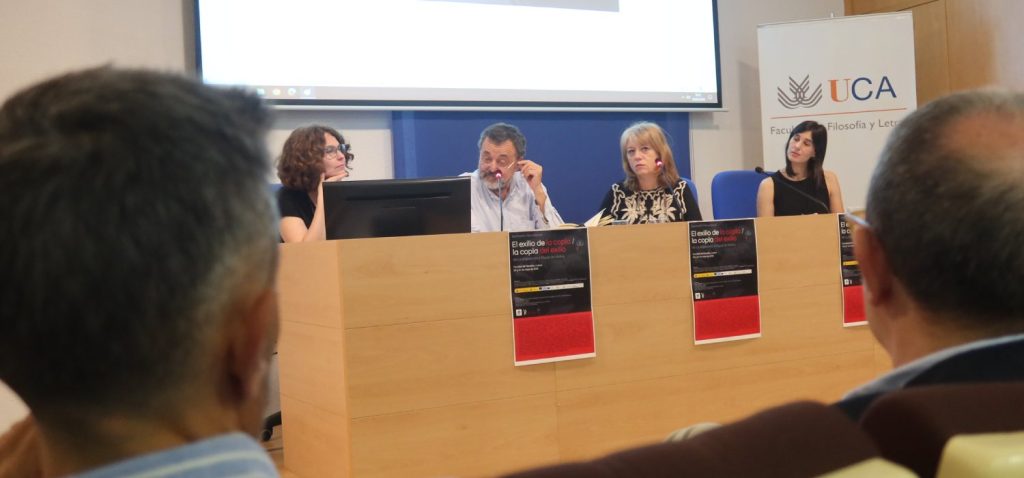
International experts examine the careers of artists such as Miguel de Molina and explore the relationship between popular song and exile during the Franco dictatorship
The University of Cádiz inaugurated this Wednesday the international seminar Copla in Exile / The Exile of Copla, an academic gathering bringing together specialists, researchers and cultural professionals at the Faculty of Arts and Humanities to analyse the historical, cultural and social dimensions of copla from an interdisciplinary perspective. The initiative proposes a reflection on the role played by this musical genre during the exile and displacement processes experienced by many Spanish artists, as well as on the evolution and reinterpretation of copla beyond Spain’s borders.
The opening ceremony was attended by the Dean of the Faculty of Arts and Humanities, Antonio Serrano Cueto; the seminar coordinators and researchers José Jurado and Alberto Romero; and Alejandro Saladé, President of the Miguel de Molina Foundation and great-nephew of the artist.
During the inauguration, José Jurado highlighted the need to incorporate copla into academic spaces for reflection through a broader perspective that goes beyond considering it solely as a musical or popular expression. In this regard, he stressed that “copla is music, it is popular expression, but it is also history and literature,” underlining the importance of approaching its study from an academic and interdisciplinary framework capable of exploring its multiple cultural and social dimensions.
One of the seminar’s central themes focuses on the relationship between copla and exile, a reality that marked the careers of numerous artists throughout the twentieth century. Alberto Romero emphasised the importance of revisiting certain historical interpretations traditionally associated with the genre. He explained that current research seeks to move beyond reductionist views that linked copla exclusively to a particular political period, instead highlighting the trajectories of artists who carried this musical tradition abroad.
In this context, Romero recalled how many exiled artists introduced copla to countries such as Mexico, Argentina and the United States, where the genre was embraced and integrated into local cultural contexts. This international journey constitutes one of the seminar’s main areas of analysis, particularly regarding the transnational circulation of music and its capacity to create new identities and spaces of belonging.
Special attention during the opening session was also devoted to the figure of Miguel de Molina and to the ongoing recovery and study of his documentary and artistic legacy. Alejandro Saladé thanked researchers and institutions for their efforts to preserve and promote the heritage associated with one of the most representative figures of copla and Spanish exile in the twentieth century.
In his speech, Saladé recalled Miguel de Molina’s close connection with Argentina, the country where the artist developed much of his professional career after leaving Spain and where he was able to continue performing freely. He also highlighted the extensive archival and cataloguing work undertaken in recent years to recover documents, recordings and materials linked to the artist, allowing for a deeper understanding of both his artistic and personal legacy.
For his part, Antonio Serrano Cueto welcomed participants and stressed the value of academic initiatives that allow issues related to memory, culture and exile to be explored from different perspectives. He also praised the enriching nature of a seminar that introduces new approaches to the study of copla while encouraging dialogue among researchers from different disciplines.
The seminar forms part of the research project The Artistic Exile of Copla and Flamenco: From La Argentinita to Miguel de Molina, funded by the Spanish Ministry of Territorial Policy and Democratic Memory. The initiative is organised with the collaboration of the Casa de Velázquez, the Miguel de Molina Foundation, the Department of Philology and the Institute for Research in Hispanic World Studies (IN-EMHis) at the University of Cádiz.
The programme continues through Thursday with lectures, round tables and discussion sessions addressing topics related to cultural memory, popular music, migration processes and artistic exile. Participants include specialists from national and international institutions such as the Universitat Autònoma de Barcelona, Sorbonne Université, Complutense University of Madrid, University of Memphis, University of Murcia and the CSIC School of Hispano-American Studies in Seville, alongside numerous researchers from the University of Cádiz and representatives of cultural organisations linked to copla, flamenco and historical memory studies.