

“University culture should not be lived in isolation; it must engage with its environment, build alliances and create shared cultural ecosystems” 27 April 2026
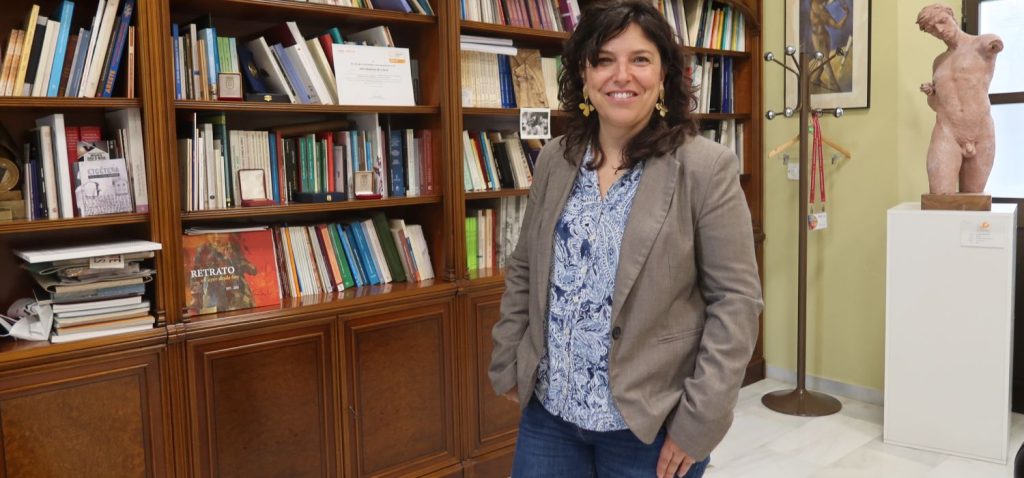
The Director General of Culture at the University of Cádiz, Ester Trigo, reflects on the institution’s cultural strategy, the role of reading communities, and the importance of collaboration with other entities in strengthening the university’s cultural ecosystem.
What assessment does the Directorate General of Culture make of this year’s University Book Week?
The assessment is very positive. Together with the Library Service and the University Extension Service, we have managed to structure a broad Book Week, with 21 activities distributed across the four campuses and open both to the university community and to society as a whole.
I believe this edition has had three main strengths: the ability to turn reading and culture into a shared, territorially distributed experience; the success of dedicating it to José Manuel Caballero Bonald; and the combination of memory, contemporary creation and participation, with very diverse proposals such as exhibitions, presentations, meetings, public readings and activities in libraries and university spaces.
It is also important to highlight the involvement of many units, individuals and partner institutions such as the International Network of Reading Universities, the city councils of Puerto Real and Jerez, and the UCA Publishing Service.
Culture works better when it is understood as a shared task. The Book Week has reinforced reading, critical thinking, literary memory and the role of the university as a cultural agent in its environment.
This year’s Book Week has been dedicated to José Manuel Caballero Bonald. Beyond the centenary of his birth, why was this author chosen?
Because 2026 marks the centenary of his birth, but not only for that reason. He is also a major figure in contemporary Spanish literature, and his work embodies values that are essential for a university, such as intellectual rigour, critical awareness, memory, the relationship between language and thought, and a very lucid perspective on identity and culture.
He is a figure deeply linked to Jerez, the province of Cádiz and Andalusia, but also directly connected to the University of Cádiz, which awarded him an honorary doctorate in 2004 and preserves documentary traces of his career in its Archive.
A third reason is that his figure allows us to build a very diverse programme. Through Caballero Bonald we have been able to combine literature, heritage, archives, public reading, intergenerational dialogue and collaboration with key cultural institutions.
The centenary is an excellent opportunity, but the choice is mainly based on the fact that his legacy remains fully relevant for thinking about what culture means today in a public university.
“Caballero Bonald’s figure has allowed us to build a diverse programme combining literature, heritage, intergenerational dialogue and collaboration with cultural institutions.”
The University of Cádiz is working on the development of reading communities. What can you tell us about this initiative?
We want reading to become part of university life as a shared, open, intergenerational practice connected to the social environment.
To that end, starting in September, with the help of the Communication and Marketing Office, we will launch a proposal for students to get involved in programmes such as “Literary Presences”. We invite writers who may initially be unknown to younger audiences but whose works we believe can truly connect with them.
We are currently working in several directions. On the one hand, through cultural and library programming with activities that promote reading. On the other, through the creation and consolidation of stable spaces such as reading clubs.
We also consider it essential to train reading mediators, because reading communities do not emerge only through affinity; they require guidance, dynamisation and continuity.
We will also be present at the International Summer School with a course on reading mediation and community. In addition, we are involving the International Network of Reading Universities through initiatives such as International Conferences on Children’s and Young Adult Literature and within the university’s summer course programme.
In May, writer Sabina Urraca will take part in the Literary Presences series. How are these events received within the university community, and what do they contribute to the UCA cultural agenda?
These meetings are very well received, largely due to their long-standing trajectory and format. “Literary Presences” is not an improvised or occasional activity, but a well-established cultural cycle that has been part of the university for decades, creating a space for direct encounters with prominent writers.
It works well because it encourages conversation, listening and shared thinking. A key added value is that these meetings are recorded, allowing us to reach a wider audience, especially in Latin America.
In the case of Sabina Urraca, we are talking about a very distinctive contemporary author with a highly personal voice. Her presence brings contemporaneity, literary risk and a direct connection with current writing.
“Literary Presences provides continuity, quality and openness to new cultural horizons.”
How important is collaboration with other public and private entities for the University of Cádiz’s cultural activities?
Collaboration is fundamental. We do not see it as an accessory, but as one of the foundations that makes a richer, more open and more impactful cultural programme possible.
Today it is inconceivable to develop cultural programming without combining personal and financial efforts. The university contributes academic criteria, public vocation and organisational capacity, while partner institutions contribute resources, networks, expertise, heritage, visibility and access to different audiences.
This collaboration allows us to work on a broader scale and to bring in leading authors, develop better-documented exhibitions, and promote specialised cycles.
It also makes it possible to connect the university’s cultural agenda with key cultural institutions in the region.
But there is something even more important: collaboration reinforces the idea that university culture should not be lived in isolation. A public university must engage with its environment, build alliances and create shared cultural ecosystems.
“Beyond strategic positioning, collaboration with other entities reinforces the idea that university culture should not be lived in isolation.”
What projects is the Directorate General of Culture currently working on?
We are currently working on several projects that respond to a single idea: building a stable, open, participatory university culture present across all four campuses.
We aim to consolidate cycles such as Literary Presences, Campus Cinema, Campus Jazz and Campus Rock, while continuing to develop training initiatives in photography, jazz, modern music, cinema, dance and flamenco.
We have also signed agreements with cultural institutions and initiated collaborations with artists, alongside programmes such as Campus Crea, Campus Cinema, Gastro UCA and other CELAMA activities.
We are also promoting creation and talent through competitions such as the Rapid Painting Contest and the “Veo-Veo” mobile photography competition.
Finally, we are strengthening social outreach through initiatives such as the 76th edition of the Cádiz Summer Courses and participatory tools like Proyecto Opina 2026.
More than a single project, we are talking about a structured cultural agenda built around reading and literature, cultural training, support for creation, campus-based programming and openness to society.