

Cookies Policy

The website of the University of Cádiz uses its own and third-party cookies to carry out analysis of use and measurement of traffic, as well as to allow the correct functioning in social networks, and in this way to improve your browsing experience.

If you want to configure cookies, press the button Customize Cookies. You can also access the cookie settings at any time from the corresponding link in the footer.

For more information about cookies you can consult the Cookies policy from the website of the University of Cádiz.

Cookies customization

The website of the University of Cádiz uses its own and third-party cookies to carry out analysis of use and measurement of traffic, as well as to allow the correct functioning in social networks, and in this way to improve your browsing experience.

For more information about cookies you can consult the Cookies policy from the website of the University of Cádiz. You can also access the cookie settings at any time from the corresponding link in the footer.

You can configure the website cookies according to their purpose:

  • Statistical analysis

    Third-party cookies (Google Analytics) are used on this site that allow the number of users to be quantified anonymously (personal data will never be obtained to identify the user) and thus be able to analyze the use made by users of our service, in order to improve the browsing experience and offer our content optimally.

  • Social networks

    Third-party cookies are used on this website that allow the proper functioning of some social networks (mainly YouTube and Twitter) without using any personal data of the user.

UniversidaddeCádiz
noticia

UCAnFly’ nanosatellite team successfully completes testing to prepare Melisa-II experiment for launch 31 May 2023
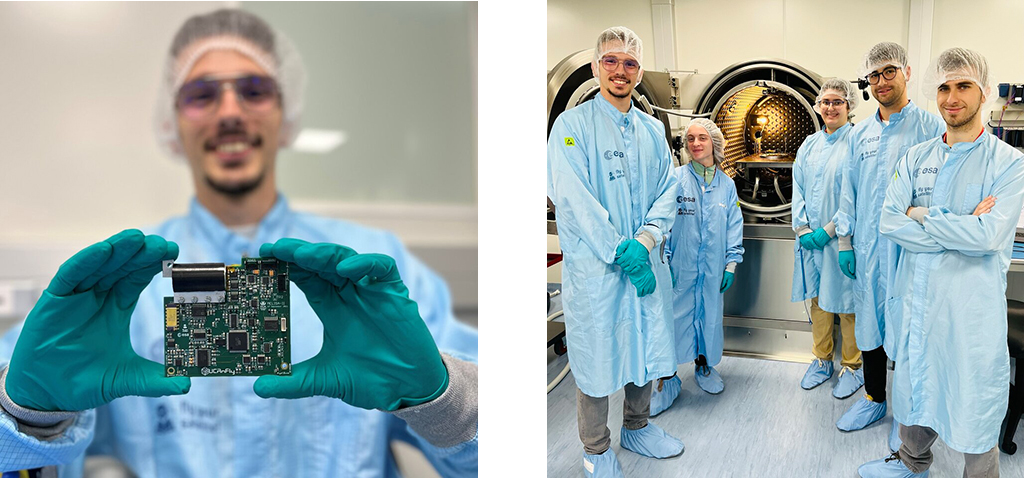
UCAnFly’ nanosatellite team successfully completes testing to prepare Melisa-II experiment for launch

The UCAnFly team from the University of Cadiz, which is currently participating in the third edition of the Fly Your Satellite program of the European Space Agency (ESA), has successfully completed the environmental test campaign, with the objective of mechanically and thermally qualifying the payload called MELISA-II which is part of the CubeSat UCAnFly. It is a magnetic measurement system that uses tiny sensors designed to detect the slow oscillations of the interplanetary magnetic field.

To ensure the accuracy of the measurements and increase the technological maturity of this nanosatellite, the UCA team must shield the sensors from any unwanted magnetic interference. “What makes this experiment special is that the sensors are placed inside a small cylinder made of mu-metal (a nickel-iron alloy), which acts as a shield, minimizing magnetic disturbances,” as explained by its promoters. The launch, expected in 2025, will shed light on the system’s behavior in the harsh conditions of the orbit in the long term, allowing more reliable and precise measurements with more compact sensors and lower power consumption.