

UCAINNOVA 2025 Brings Together Patents and Projects at El Olivillo That Connect Research with Businesses in Cádiz 12 December 2025
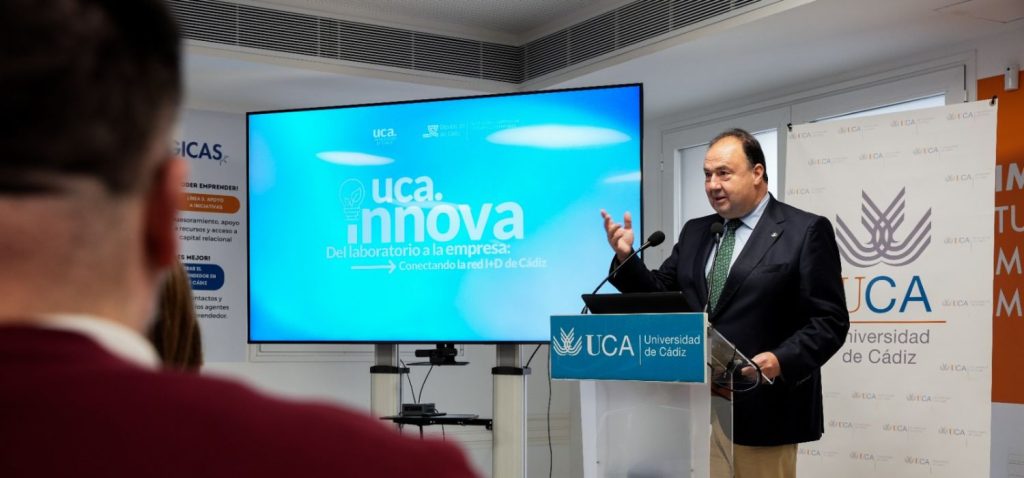
The event highlights the ‘IntraLab Teams’ and ‘Conecta tu Talento’ programmes as key pillars of the initiative’s strategy and of collaboration with the Provincial Council of Cádiz.
The University of Cádiz has held the UCAINNOVA event From the Laboratory to the Company: Connecting Cádiz’s R&D Network at the El Olivillo Business Transfer Centre. The meeting showcased some of the most recent outcomes of the IntraLab Teams and Conecta tu Talento programmes, both framed within the UCAINNOVA 2025 project and funded by the Provincial Council of Cádiz.
The event was presided over by the Rector of the University of Cádiz, Casimiro Mantell, accompanied by the Vice-Rectors for Research and Transfer, María Jesús Ortega; Internationalisation, Marcela Iglesias; and Entrepreneurship and Employability, Carmen Camelo; as well as the Director General for Business Relations and Knowledge Transfer, Raúl Severo Fernández. Also taking part were the Director of the SEA-EU Secretariat for Research and Innovation, Mercedes Ruiz, together with the research teams behind some of the technologies presented.
Raúl Severo Fernández opened the event by explaining that “the objective of UCAINNOVA is to demonstrate, through very concrete examples, how the research carried out at the University of Cádiz is being transformed into useful solutions for citizens and into opportunities for companies across the province”.
At the core of the programme, three technologies developed within IntraLab Teams were presented in an accessible, outreach-oriented format. This programme analyses the transfer potential of patents and software developed at the University of Cádiz for their incorporation into the socio-economic fabric.
First, student José Dodero, from the Higher School of Engineering of the University of Cádiz, presented a portable automated numismatic photography system that addresses a long-standing challenge faced by museums and archives: the difficulty of photographing coins—due to their relief and metallic sheen—in a rapid and uniform manner. This portable system standardises lighting and image capture, enabling the mass digitisation of numismatic collections and facilitating their conservation, study and dissemination.
Next, researchers Juan Jesús Fernández and José María Palacios, both from the Department of Analytical Chemistry, explained the operation of a device designed to monitor foetal wellbeing during childbirth. The system is sensor-based and minimally invasive, allowing real-time, remote monitoring of foetal health. It provides key information to support clinical decision-making and contributes to improving the safety of both mother and newborn.
Finally, Professor Mercedes Ruiz, from the Department of Computer Engineering, presented GoRace, a web-based gamification platform that transforms the achievement of real objectives (sales, training tasks, projects, etc.) into visible progress within a virtual race. The tool allows customised challenges to be designed and enables real-time tracking of team performance, using game mechanics to increase motivation and productivity in business and educational environments.
Twelve Technologies Analysed and a Network in Motion
In addition to these three patents, the current edition of IntraLab Teams has worked on other technologies, including a healthy ice cream made with grape pomace for people with diabetes (developed by Alfonso Lechuga and Enrique Durán); biomarkers to predict severe atherosclerosis (María del Carmen Durán); a modular cell therapy against cancer (Francisco José García-Cózar); insulated façades incorporating solar energy (Ismael Rodríguez); a method for determining the sex of fish at early stages (Alejandro Centeno); the REDIBAGG artificial intelligence accelerator (Esther Lydia Silva); and proposals for learning to programme through play with the support of intelligent assistants (EsCode Room and NAVI Assistant, developed by teams led by Mercedes Ruiz, Rubén Baena and Iván Ruiz).
“Behind each of these technologies there are people with names and surnames, years of work, and a very clear commitment to the needs of our environment,” stressed Rector Casimiro Mantell, who emphasised that “for the University of Cádiz, patents are not an end in themselves, but a tool for transferring knowledge with guarantees to the productive and social fabric of the province”.
International Research with Local Impact
The event also served to highlight the outcomes of Conecta tu Talento, a call which, within the framework of UCAINNOVA 2025 and the SEA-EU European University alliance, funds complementary research actions developed in collaboration with partner universities and oriented towards strategic challenges in the province of Cádiz.
In its most recent edition, 14 projects across all fields of knowledge have been supported, with strong involvement from early-career researchers. Among them, the Rector highlighted the AI4Onion project, coordinated by José Luis Pérez, which is developing an artificial intelligence-based platform to authenticate onions from Cádiz and Brittany, thereby protecting local produce; EXTRAE-SUR, led by María José Aliaño, focused on the use of sustainable solvents to valorise agroforestry waste; and the initiative on active employment policies for vulnerable groups between Naples and Cádiz, coordinated by Mª Cristina Aguilar, which analyses and shares good practices in labour market inclusion.
According to the Rector, these projects demonstrate “how UCA’s talent connects with Europe without losing its roots in Cádiz: research stays, seminars and pilot studies are designed with very specific challenges of the province and its productive sectors in mind”.
UCAINNOVA 2025, which encompasses IntraLab Teams and Conecta tu Talento, is a programme developed by the University of Cádiz with the support of the Provincial Council of Cádiz. Its aim is to strengthen the culture of innovation, support the creation of science- and technology-based companies, and consolidate an R&D network closely connected to the territory.
In his closing remarks, Casimiro Mantell expressly thanked the Provincial Council for its support and extended an invitation to companies across the province, stating that “we want them to see the University of Cádiz as a partner with whom they can explore projects, technology licences and new business initiatives. Our intention is to continue identifying results with potential, supporting them and opening up new avenues of collaboration with the socio-economic fabric and public institutions”.