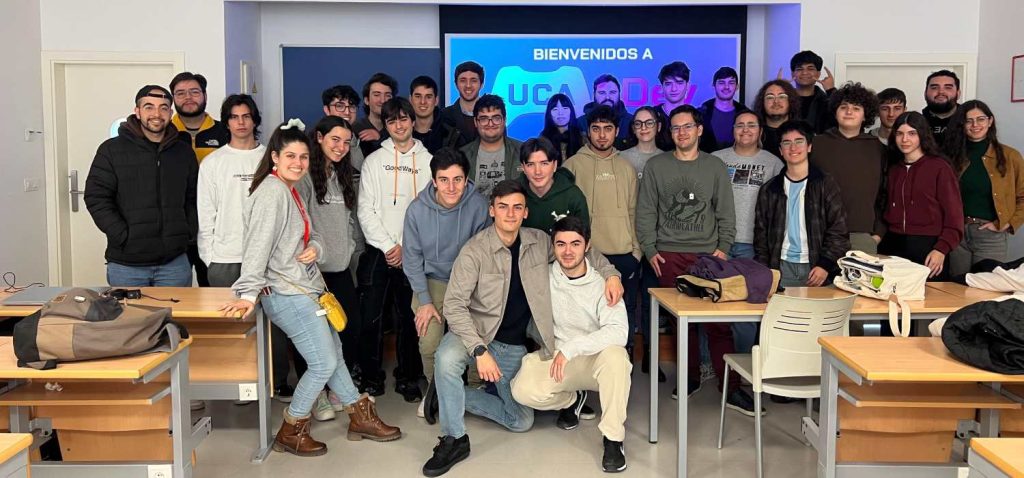

UCAinDev: excellence, creativity and student enjoyment: “Video games are the greatest form of expression and social connection” 28 November 2025
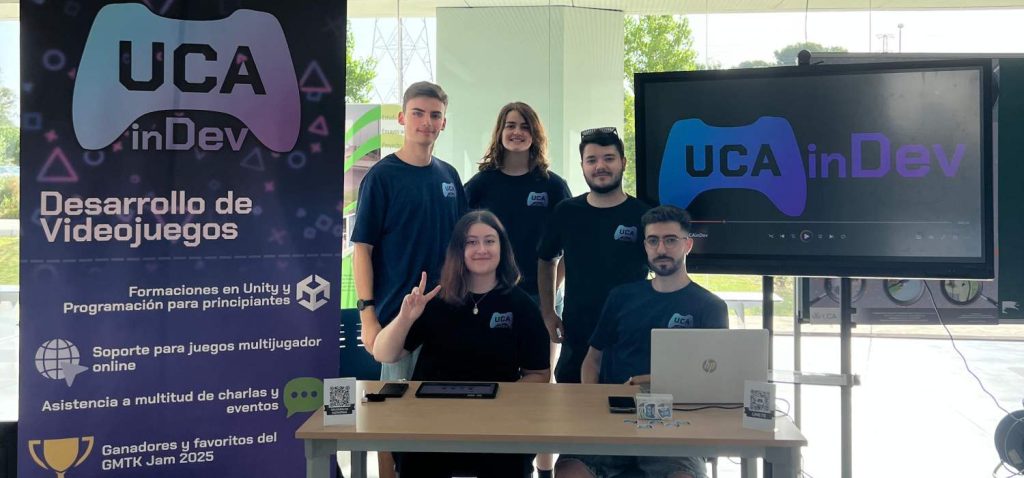
This student association, linked to the School of Engineering, showcases the work involved in video game creation and highlights it as both a form of social community and a way to enhance the value of technical knowledge.
The University of Cádiz is a large family. And in large families, it often happens that the achievements of some of the youngest siblings go unnoticed. Recently, the Vice-Rectorate for Students held its first Associations Forum, focusing on the various student groups from the four campuses. Among them, one of the associations that took the floor was UCAinDev, made up of young video game developers. They spoke about the challenges of creating a student association and the difficulties they face and, almost without giving it importance, mentioned that they had taken part in an international video game competition, the GMTK Jam 2025, where one of their creations had become the top-rated entry and two others had also achieved excellent results. As in any family, the work of its members must be recognised, and this week the spotlight is on UCAinDev, an association led by President Javier Olvera, Vice President Víctor José Ayllón, Secretary Alicia Oliva, and Treasurer Alberto López. Jesús Fernández, an active member of the association, also joined the interview.
For those who read through to the end of the interview, there will be no final boss—only a reward.
What activities does UCAinDev carry out, and since when has it been active?
Javier Olvera (J.O.)
UCAinDev is an association based at the School of Engineering, focused on video game design and development. It began operating in 2019 thanks to the initiative of a group of students from the School, long before my arrival and that of the current Board. In 2021, they had to pause their activity due to the COVID-19 pandemic, but last academic year, 2024–2025, with the arrival of a new Board, we have managed to revive the association. We are dedicated to training our members in the design and development of video games from scratch, providing them with the means and support they need to enter this incredible field and to help them publish the games they create. Each participant is unique, each with different tastes in genres, styles, art, and mechanics. UCAinDev is a workshop that sparks the creativity of these minds full of ideas and dreams, whose only limitation is the difficulty of entering this sector alone.
How many students make up UCAinDev? What is your relationship with the School of Engineering?
J.O.
In the past two academic years, around 100 students have taken part in our activities. At our weekly meetings, we usually have around 30 members who attend regularly. As for the second question, the School of Engineering gathers all the degrees whose students fit the profile we are looking for, so making the association known is not difficult. And not only because of the recreational side of video games, but also because of our technical and artistic approach to the work, which indirectly reflects the subjects many of our participants are currently studying. They put this knowledge into practice in one of the most rewarding and enjoyable ways possible: by creating the video game they have always dreamed
At the last associations meeting organised by the Vice-Rectorate for Students, the importance of students joining associations was highlighted. Why is it necessary for students to come together?
Jesús Fernández (J.F.)
Because being part of a university association allows you to work as a team and learn new things about topics that genuinely interest you—in our case, development in different areas of computing. It allows us to share knowledge and create professional projects by taking advantage of the individual strengths of each member, helping everyone develop their skills.
Do you think that the mechanisms currently in place to inform students about the existence of associations are adequate? How could this be improved?
Víctor José Ayllón
It’s difficult. For example, at the School of Engineering there are so many students that reaching all of them can be complicated. The challenge is not getting people interested in joining us, but making sure they know the association exists in the first place. At the Welcome Day we do have a space to introduce ourselves to new students, but reaching returning students is more challenging. One initiative that could really help associations would be to organise an Associations Fair. It would be a great opportunity to foster interaction and would provide valuable insight into the amazing university environment that exists behind so many exams and assignments.
Alicia Oliva
As Víctor José mentioned, attending to all the associations at the ESI is a complex task, and giving visibility to all of them even more so. The fact that so many student associations exist—around a dozen right now—says a lot about the School, and shows there is a very positive creative and collaborative atmosphere. The Associations Forum is a fantastic initiative and shows us how we should move forward in the future. I think a positive way to showcase what students do through associations would be to share posts on social media through official UCA or ESI accounts. Ultimately, it’s a relatively new area with a lot of potential, and we are eager to improve it together.
It is striking that, despite the strong link between the computing sector and online training, the courses and events you organise attract a large audience. Does the video game sector still carry the stigma of being an activity for young people who are not very sociable? What would you say to those who still think that way?
Alberto López
Not at all. Even though this stigma weighed on the sector for many years, today there are few things that bring a generation together more. I can give a few examples we have all probably experienced: playing Wii games in the living room with your family, playing a few FIFA matches with friends, or even mothers reaching the highest level on Candy Crush. Video games are one of the greatest forms of expression and social connection; they bring us all together under the same roof of fun, regardless of our differences. To people who still think video games are just for “nerds”, I would say I’m quite sure they know at least one famous person who plays just like anyone else. For example, Henry Cavill (Superman), a huge fan of the Warhammer franchise, or Kylian Mbappé, a well-known follower of the Top Spin2K series.
Last summer, three of your members represented the UCA at the GMTKJam2025. What was the experience like?
J.O.
GMTK Jam is a well-known international event held online through the itch.io platform. A surprise theme is announced, and you then have 96 hours to create a video game from scratch. In the edition we took part in, the theme was LOOP, meaning repetitive events. I had been following this competition for several years and had taken part before. Last year, I suggested joining it as an association, and two colleagues decided to participate with me.
The experience was, above all, a challenge. I had to develop a full video game on my own: logic, code, art, interface, sound, script… all in just four days, and without much time to calmly think about what kind of game I wanted to make. The clock starts ticking the moment the theme is announced. This was the first edition in which “Narrative” was evaluated, so I decided to focus on a mystery story with puzzles and time jumps that fit the idea of a loop. It turned out very well: my entry was one of the favourites, both among participants and for the organiser himself.
It was an intense and exciting experience. I would definitely love to take part again.
J.F.
I’ll tell you how I experienced it. GMTK Jam 2025 was a memorable event. This year I took part for the first time, testing my skills on my own using the Unity game engine. The rule was to create a game from scratch based on a theme revealed at the start, and within 96 hours. Despite competing against full teams with very experienced developers, I managed to place 161st in the Narrative category and 786th overall, out of more than 10,000 submitted games. I’m very happy with the result, especially considering I’m still learning the engine in depth. For me, it has been a great achievement and a motivation to keep learning and improving for future editions.
What challenges lie ahead for UCAinDev?
J.O.
At UCAinDev, we are certain that we will take part in GMTK Jam 2026 as soon as it is announced, aiming for one of our games to reach the top positions. In addition, we would like to organise our own UCAinDevJAM, where our members can present the games they have created during the year, and we can vote on the winners among ourselves.
As promised, here is the reward at the end of the interview: the three video games developed by UCAinDev members for the GMTK Jam 2025:
Night O’Clock: Winner in the “Favourite” category and sixth place in “Narrative.” Created by Javier Olvera.
Brooke’s Nightmare: Created by Jesús Fernández.
An Ever-changing Cave: Created by Pablo Beato.