

UCA Strengthens Faculty Development with the Third Edition of Its Initial University Teaching Training Programme 9 June 2026
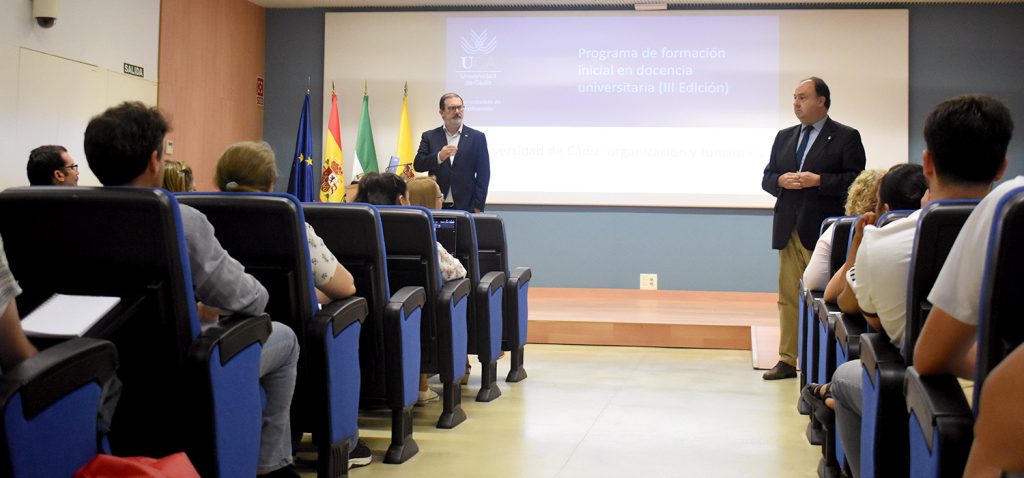
The 100-hour programme, running from June to July 2026, focuses on teaching innovation, assessment, digital learning and the challenges posed by artificial intelligence in higher education.
The University of Cádiz officially launched the third edition of its Initial University Teaching Training Programme on Tuesday, an initiative designed for newly appointed teaching and research staff. Running from 2 June to 16 July 2026, the programme offers a total of 100 hours of specialised training aimed at supporting academic staff in the development of their teaching careers.
The opening session was attended by the Rector of the University of Cádiz, Casimiro Mantell, and the Vice-Rector for Academic Staff, José Antonio Perales, both of whom highlighted the importance of preparing university lecturers and researchers to respond to the profound changes currently reshaping higher education.
In his address, Rector Mantell underlined the growing complexity of university teaching. “We are moving towards increasingly specialised forms of teaching,” he noted, pointing out that while student numbers remain similar to those of 25 years ago, the University’s academic offer has expanded significantly through a greater number of degree programmes and areas of specialisation.
Mantell also reflected on some of the challenges that will shape the future of universities, particularly those arising from the rapid development of artificial intelligence. He stressed the need to rethink assessment models and even the concept of examinations themselves in a context where AI tools are transforming the ways in which knowledge is created, accessed and learned.
Another issue highlighted by the Rector was the impact of demographic trends on higher education. With forecasts indicating a decline in student numbers over the coming years, he emphasised the need for universities to adapt to a changing environment. “The market is global,” he remarked, advocating for continued progress in the internationalisation of the University of Cádiz as a means of attracting students from around the world.
Vice-Rector José Antonio Perales focused on the evolving role of university teachers. According to Perales, in an environment where access to information is increasingly immediate, academic staff must place greater emphasis on fostering critical thinking, analytical skills and the effective communication of knowledge.
“The role of the lecturer should not be limited to providing content, but should also encourage students to think critically and develop their ability to communicate ideas,” he explained. Referring to the emergence of generative artificial intelligence, he suggested that one of the key educational challenges will be teaching students how to formulate effective prompts and questions, as well as how to interpret and communicate the information generated by AI systems.
Perales also stressed that the programme is intended to serve as a space for reflection on the future of higher education. “This course should help us consider the challenges facing universities twenty years from now,” he said. In this context, he highlighted the importance of maintaining flexible academic structures capable of adapting curricula to emerging social, professional and technological demands.
The training programme covers a wide range of topics, including university governance and organisation, course planning, quality assurance, professional ethics, sustainability, gender perspectives, occupational health, academic guidance and mentoring, teaching methodologies, digital education, internationalisation, student assessment and educational innovation.
Sessions are delivered both in person and online at various University of Cádiz facilities, primarily within the Faculties of Science and Education Sciences on the Puerto Real Campus. The programme combines theoretical content, practical tools and opportunities for reflection on the present and future of higher education.
With this third edition, the University of Cádiz reaffirms its commitment to the continuous improvement of teaching quality and to the preparation of academic staff capable of addressing the challenges of a university sector undergoing constant transformation.