

UCA hosts an international conference on female elites and cultural production during the transition from the 18th to the 19th century 27 November 2025
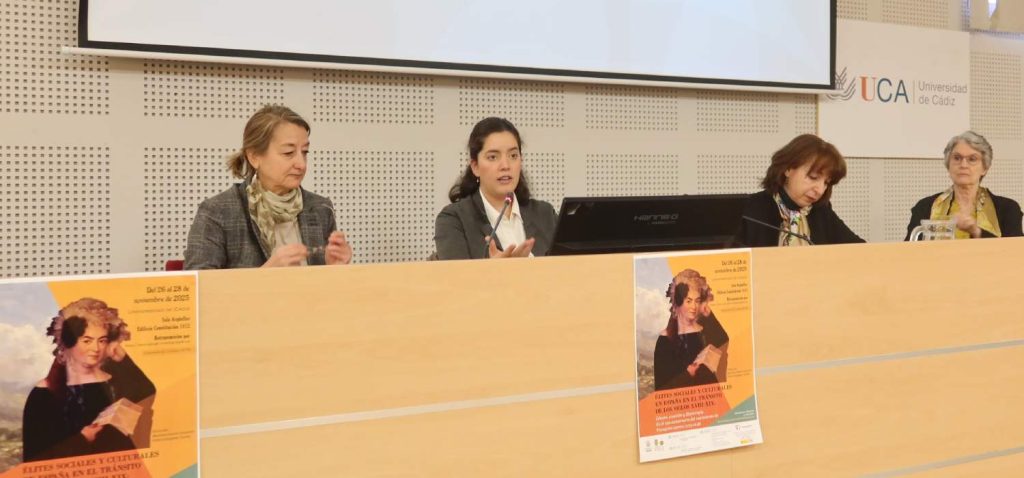
The activity, which was introduced in Bornos, has been organised by the Research Institute for Hispanic World Studies to mark the anniversary of the birth of Frasquita Larrea
The Research Institute for Hispanic World Studies (In-EMHis) at the University of Cádiz is hosting this week the international conference Social and Cultural Elites in Spain during the Transition from the 18th to the 19th Century: Gender, Cultural Production and Philanthropy, held as part of the commemorations of the 250th anniversary of the birth of Frasquita Larrea (1775–1838). The programme, which is taking place between Bornos and Cádiz, has brought together national and international specialists to reflect on the role of enlightened women, female sociability networks, and the forms of activism developed during this historical period.
The opening session took place on Wednesday in the town of Bornos, birthplace of Frasquita Larrea, where her work as a writer, translator, traveller, and promoter of Enlightenment culture was highlighted. Through a series of presentations, the contributions of women who, like her, took part in spaces of power and intellectual production that have often been overlooked by traditional historiography were brought to the forefront.
During the second day, held on Thursday in the Argüelles Hall of the Constitución de 1812 Building, attention turned to the analysis of the juntas de damas as arenas of public intervention led by women. Professor Elisa Martín-Valdepeñas, from the National Distance Education University (UNED), outlined the nature of female education within religious institutions of the time, emphasising the influence of moral principles on pedagogical models. Her talk shed light on the tensions between education and moral discipline at a key moment in the history of Spanish schooling.
For her part, Fátima Salaverri, from the University of Cádiz, delivered a presentation on the political impact of Cádiz’s philanthropic women in the 19th century, highlighting the role of the Junta de Damas de Cádiz and the significance of members of the Rábago family. Recently awarded the Prize for Best Doctoral Thesis by the Andalusian Studies Centre, Salaverri analysed how these women played an active role in public welfare and education, establishing themselves as agents of social transformation within the civic sphere.
The conference, directed academically by professors Marieta Cantos—director of In-EMHis—and Gloria Espigado, is organised around three thematic lines: women’s writing and sociability networks; philanthropic management and the juntas de damas; and representations of femininities and masculinities in transition. Among the organising and collaborating entities are the Vice-Rectorate for Sustainability and Culture, In-EMHis, the research groups HUM-139 and HUM-306, and the Departments of Philology and of Modern, Contemporary, American and Art History, with funding from the TRAMOS project and institutional support from the City Councils of Cádiz and Bornos.
The conference will conclude on Friday with further presentations and a guided tour of “Frasquita Larrea’s Cádiz”, led by Professor Marieta Cantos, offering participants a closer insight into the legacy of this key figure in the history of female Enlightenment thought.