

UCA Contributes to the Promotion of New Sustainable Cork Applications through FUTURECORK, Concluding with a Final Conference in Barcelona 9 January 2026
The University of Cádiz (UCA) is taking part in the promotion of new sustainable applications for cork through the national project FUTURECORK, which has concluded with its final conference in Barcelona.
The INNANOMAT research group is involved in this initiative, which seeks to contribute to the diversification of the cork sector through the development of cork-based composite materials, additive manufacturing, and prototypes for design and construction.
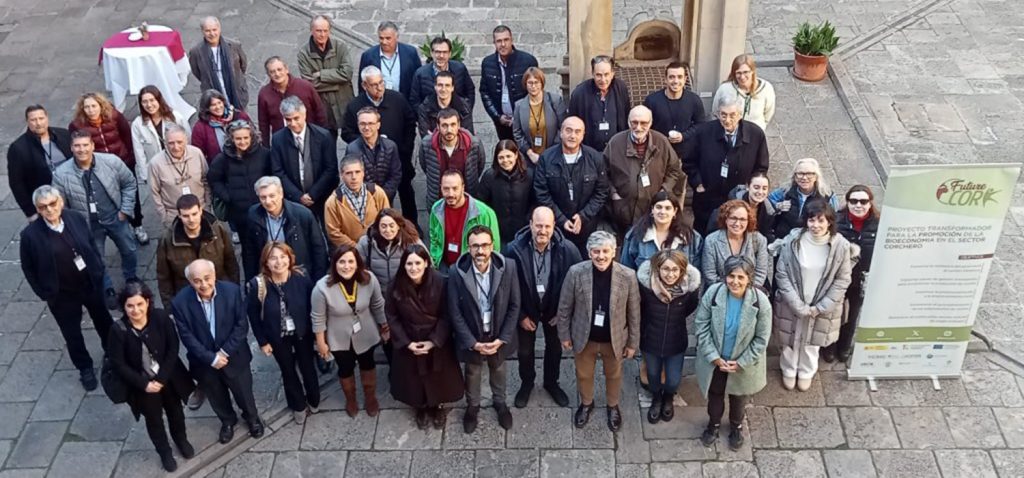
The state-level project FUTURECORK, aimed at promoting the bioeconomy and strengthening the competitiveness of the cork sector, held its final conference in Barcelona under the slogan FUTURECORK: A Look into the Future of Cork. The event brought together more than fifty participants at the Institut d’Estudis Catalans (IEC), including members of the INNANOMAT research group, coordinated by Professor Sergio Molina.
As a member of the project consortium, the University of Cádiz contributes—through research and knowledge transfer—to opening up new avenues for the use of cork and its by-products, linking technological innovation, sustainability, and opportunities for industrial diversification. FUTURECORK has focused on strengthening the resilience of cork oak forests, improving productivity, fostering rural entrepreneurship, diversifying cork applications, and enhancing communication within the sector.
The initiative has had a total budget of €1.4 million and has been supported by the Biodiversity Foundation (MITECO) within the framework of the Recovery, Transformation and Resilience Plan (PRTR), with funding from NextGenerationEU.
During the final conference, state-level milestones were presented, including management, regeneration, and monitoring actions covering 25,941 hectares of cork oak woodland, as well as the training of 970 people through technical programmes, courses, and sector-specific workshops. These activities included the promotion of the first officially accredited national training course for cork harvesters.
Specifically, UCA has participated in FUTURECORK through the INNANOMAT research group, part of the Institute of Electron Microscopy and Materials (IMEYMAT), developing outcomes aimed at diversifying cork applications towards sectors such as design and construction. These results include the design and manufacture of furniture, lighting, and decorative elements made from sustainable materials developed within FUTURECORK, as well as samples of cork-based composite materials and large-format 3D-printed components, highlighting the potential of cork as a versatile, low environmental impact resource.
UCA’s involvement has also extended to outreach and knowledge exchange activities within the local territory, such as the innovation and entrepreneurship workshops held in Arroyomolinos de León (Huelva), organised in collaboration with other consortium partners. These sessions addressed new technologies, valorisation strategies, and applications of cork in industrial design.
Project outcomes also include analyses and technical reports related to sustainability, such as carbon footprint studies of cork products. For example, in the case of natural cork stoppers, the published assessment—taking into account carbon sequestration by cork oak forests—shows a net negative carbon footprint.
FUTURECORK is being developed by a national consortium comprising the Consorci Forestal de Catalunya (CFC), the Centre for Scientific and Technological Research of Extremadura (CICYTEX), the Confederation of Forest Owners’ Organisations of Spain (COSE), the Institute of Forest Sciences (ICIFOR, INIA-CSIC), the University of Cádiz (UCA), and the Catalan Cork Institute (ICSuro), which acts as the coordinating entity.