

UCA Completes Second Campaign of the Karnak Stones Project, the Only Spanish Mission Authorised in the Complex 6 March 2026
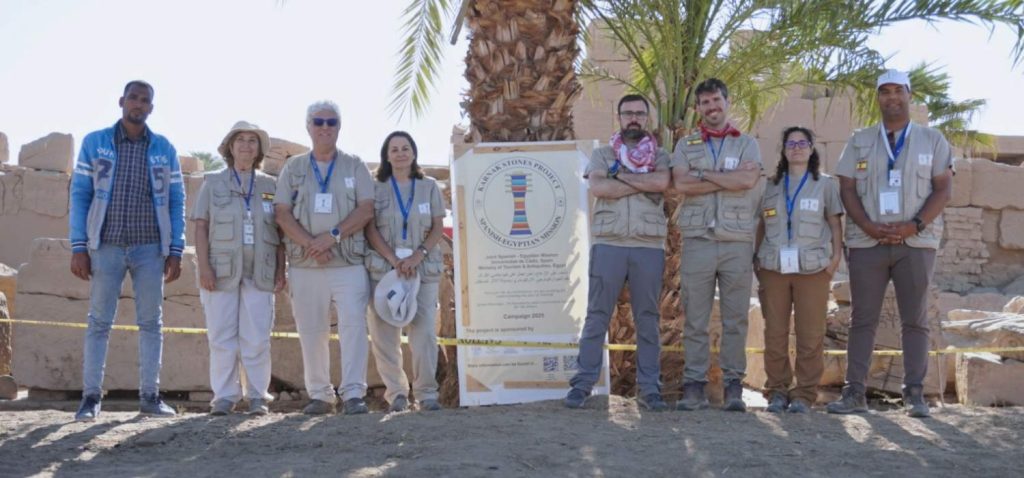
The research team is documenting and conserving hundreds of previously unrecorded blocks and has also carried out georadar surveys for the first time in one of the oldest areas of the site.
The University of Cádiz research group HUM-1129 (Archeos) has completed the second phase of its Spanish-Egyptian mission in Luxor, the Karnak Stones Project (KSP). Co-directed by Dr Abdelrhman Fahmy and Professor Eduardo Molina-Piernas, the initiative is currently the only Spanish mission with an active permit to conduct research within the Karnak Archaeological Complex, a site where research authorisations are exceptionally limited, highlighting the scientific and heritage value of the project.
The KSP is focused on the preservation of World Heritage and centres on the documentation, characterisation and conservation of the construction materials used in the Temples of Karnak in Luxor (Egypt), one of the largest religious complexes of the ancient world. The Temple of Karnak, recognised as a UNESCO World Heritage Site, is located on the eastern bank of the Nile, about 500 kilometres south of Cairo, and is one of the largest and most monumental archaeological sites in the world, covering an area of approximately 30 hectares.
The work carried out by the UCA research team has taken place in two campaigns: the first between August and September 2024, and the second between November and December 2025. During the most recent campaign, the project expanded its research into a new area containing hundreds of undocumented sandstone blocks, dated to the reigns of Thutmose III and Ramesses II. This sector is considered to be of exceptional archaeological value, as it may help clarify the historical and architectural development of the complex and has never previously been excavated.
Initial observations suggest that the area could include some of the oldest preserved contexts within the enclosure, providing valuable evidence for interpreting construction phases, later reuse of materials and ritual activities within the site.
Objective: a comprehensive study of thousands of architectural blocks at Karnak
Planned to run for ten years (2024–2033), the Karnak Stones Project is establishing itself as a long-term international research initiative. It is based on an innovative approach that applies non-destructive techniques rarely used in Egypt to analyse the origin, characteristics and conservation of building materials.
The project’s overall objective is to undertake a comprehensive study of the thousands of architectural blocks scattered across Karnak, originating from different historical phases and made from a variety of rock types. Together, these elements form an archaeological puzzle of immense historical and scientific value.
The methodology combines advanced technologies, such as high-resolution 3D documentation, digital mapping and scientific conservation tools, with a rigorous archaeological approach. Key activities include photographic documentation, cataloguing and systematic recording of blocks and ashlar stones, as well as mineralogical and petrographic analysis, the study of deterioration processes affecting the materials, and restoration and conservation interventions on architectural elements.
New techniques applied within the archaeological site
One of the major milestones of this second campaign has been the consolidation of several blocks with varying degrees of deterioration, aimed at evaluating the effectiveness of conservation treatments and their potential application on a larger scale across the site.
In addition, the project achieved a particularly significant advance through the pioneering use of ground-penetrating radar (GPR) in an unexplored area within the Karnak archaeological enclosure. This makes the second campaign an exceptional intervention in a site where archaeological work is subject to strict restrictions.
The georadar survey has been designed to detect the possible presence of buried structures in one of the oldest areas of the complex, in line with hypotheses raised by recent studies. Although the results are still being analysed, preliminary observations are considered promising and may help guide the selection of excavation areas for the third campaign scheduled for late 2026, which will be led by Professor Macarena Lara.
An interdisciplinary research team
The Karnak Stones Project team has a strongly interdisciplinary profile and is composed mainly of researchers from the University of Cádiz. Members of the mission include Abdelrhman Fahmy (director), Eduardo Molina-Piernas (co-director), Salvador Domínguez-Bella, Ana Durante, Macarena Lara and José Luis Ramírez, together with María Josefa Fernández (UNED). The team also includes specialists and technical staff in archaeometry, archaeology, heritage conservation and restoration from Spain and Mexico.
The mission is carried out in collaboration with Egyptian authorities and staff from the archaeological complex, strengthening the scientific and cultural ties between both countries.
The results of the first campaign (2024) have already attracted national and international attention, and the project has strong prospects for future scientific publications, conferences, exhibitions and educational materials. In this way, the Karnak Stones Project goes beyond strictly academic research, contributing to international cooperation and the social dissemination of knowledge about Egyptian archaeological heritage.
During the campaign, the team also received a visit from the Spanish archaeological mission working at the Mortuary Temple of Thutmose III in Luxor, directed by Professor Myriam Seco from the University of Seville. She also participated last summer in the course organised by the University of Cádiz, “UCA and Ancient Egypt: an interdisciplinary journey into heritage and tourism,” strengthening scientific collaboration among Spanish teams conducting research in Egypt.