

The University of Cádiz opens the Testaccio Haliéutico of Gades to the public 12 December 2025
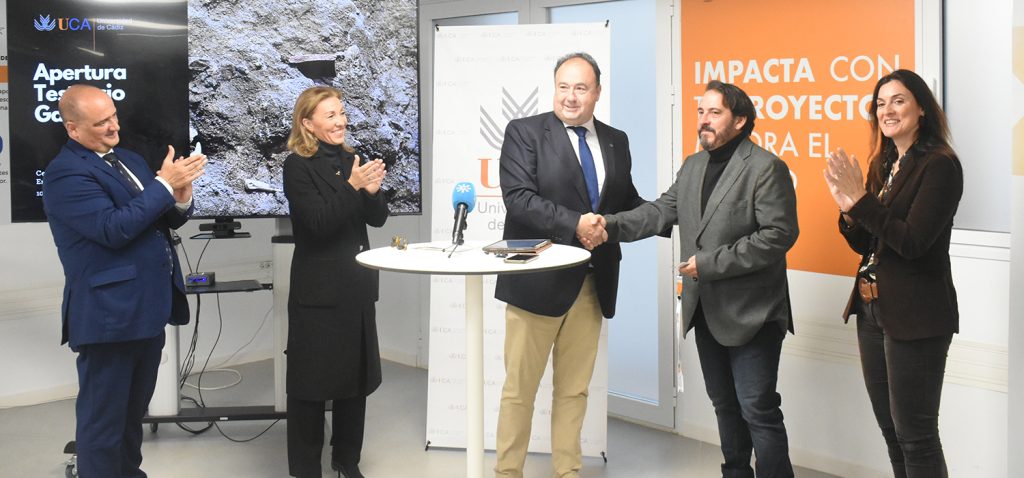
The archaeological museum, managed by the company TripMilenaria, offers a direct insight into Roman Cádiz and its relationship with the city’s ancient fishing and fish-processing industries.
The University of Cádiz has officially inaugurated the Testaccio Haliéutico of Gades, an archaeological site that reveals the existence of an extraordinary Roman waste mound linked to the city’s ancient fishing and fish-preserving industries. Unique in both its scale and state of preservation, it becomes the first museum of the University of Cádiz, a milestone that distinguishes the institution at national level, given the scarcity of university-run archaeological museums in Spain.
The event took place at the El Olivillo building, beneath which the archaeological crypt is located, and was presided over by the Rector of the University of Cádiz, Casimiro Mantell. He was joined by the Regional Delegate for Tourism, Culture and Sport of the Regional Government of Andalusia in Cádiz, Tania Barcelona; the Councillor for Housing and Sustainable Development of the Cádiz City Council, Ana Sanjuán; and Darío Bernal, Professor in the Department of History, Geography and Philosophy and Head of the UCA Research Group in Archaeology. Also in attendance were Juan Miguel Pajuelo and Francisco Javier Ramírez, managing directors of TripMilenaria, the company responsible for managing cultural, educational and tourist visits to the site, along with other members and representatives of the University of Cádiz.
An exceptional site in Roman Cádiz
Discovered in 2016 during the refurbishment works of the El Olivillo building, which was being converted into a Business Transfer Centre, the Testaccio of Gades preserves more than five metres of stratigraphic depth and an extraordinary volume of archaeological material. This allows for the reconstruction of maritime trade between the 1st century BC and the 1st century AD. Its name refers to the famous Monte Testaccio in Rome, a large mound formed by the waste generated by the intense commercial activity of the Empire.
The archaeological crypt offers visitors a direct view of Roman Cádiz during a period of peak historical splendour, associated with the era of Julius Caesar and the influential Balbo family. Inside, visitors can observe structures, amphora deposits and remains of haliéutic activity that illustrate the importance of Gades as a major centre for the production and export of salted fish and garum.
As part of the museum display, the Regional Government of Andalusia has placed on deposit around fifty original archaeological artefacts from the El Olivillo excavations, currently held at the Museum of Cádiz, which can now be viewed in their original context.
The Rector of the University of Cádiz, Casimiro Mantell, stated that “the Testaccio of Gades was one of the initiatives the University had on the table since the beginning of our term of office. We have carried out a public tender process to generate economic value and open this site to the public through an external company. It will become one of Cádiz’s heritage jewels. The UCA has led the excavation, research and musealisation of the site with the aim of sharing with citizens the knowledge generated about a key period in the city’s history. Its discovery took place during the works at the El Olivillo building, and today we symbolically complete the handover of its digital keys.”
For his part, Darío Bernal, head of the UCA Archaeology Research Group, commented that “on behalf of the group, and of Professors José Juan Díaz and José Manuel Vargas—because in archaeology and the humanities everything is collective work—it is a great satisfaction, ten years on, to see this process brought to completion. All relevant protocols for the protection of historical heritage were applied, and we discovered a mound very similar to Rome’s Testaccio, where fishing-related products were discarded. The site was fully investigated, a book was published, and the exhibition Seven Metres of the History of Cádiz was organised. This musealisation represents a model example: the site has been discovered, protected, researched, conserved and transformed into a museum. Moreover, it contributes to job creation and stands as an example of coastal and blue economy supporting sustainable tourism. Cádiz is a three-thousand-year-old city, and this crypt is an essential stop for anyone wishing to explore its history. We have presented content not found in other visitor sites in the city. I would like to thank the Vice-Rector for Employability and Entrepreneurship, Carmen Camelo, for promoting this project.”
From the company managing the museum, Juan Miguel Pajuelo, Managing Director of TripMilenaria, stated that “we would like to thank the University of Cádiz, the research team, the Regional Delegation and the City Council for their trust. We are a small Cádiz-based company dedicated to the management and dissemination of local archaeology. The Testaccio is an impressive space and forms part of the cultural wealth provided by Cádiz’s three-thousand-year history. Its location and the collaboration between public and private institutions have been key to generating sustainable tourism that complements sun-and-beach tourism with cultural tourism linked to the city’s history.”
The Cádiz City Council was represented at the event by Ana Sanjuán, Councillor for Housing and Sustainable Development, who affirmed that “this is a project of enormous value for the city. We must recognise the work of the University of Cádiz research team, whose scientific efforts have enabled the discovery, study, understanding and enhancement of this site. Cádiz now incorporates a unique space for delving deeper into its history. We also thank the Regional Government for the loan of artefacts that enrich the exhibition, and TripMilenaria, which will assume management of the site as it already does at other archaeological locations in the city. The Testaccio of Gades is a milestone for our local heritage, an educational resource open to citizens that strengthens our cultural identity and demonstrates the value of institutional cooperation.”
Finally, Tania Barcelona, Regional Delegate for Tourism, Culture and Sport of the Regional Government of Andalusia in Cádiz, highlighted “the University of Cádiz’s firm commitment to the conservation and enhancement of our cultural heritage. We also recognise the work of the archaeological team and the technicians of the provincial delegation. The role that TripMilenaria will play will be essential in ensuring rigorous interpretation, both for the residents of Cádiz and for visitors. This project represents an excellent opportunity to promote cultural and educational tourism. Cádiz once again positions itself as a benchmark by incorporating a new space that showcases its Roman roots and the significance of Gades as a dynamic and decisive city within the Empire.”
At the conclusion of the institutional event, attendees took part in a guided tour of the site. Visits include descent into the crypt, explanations of the production of salted fish and fish sauces in Roman times, interpretation of stratigraphic layers and deposits of amphorae and fauna, as well as a tour of the exhibition space featuring original artefacts and graphic resources.
The Testaccio of Gades is open from Tuesday to Saturday, from 10:00 to 18:00, and on Sundays from 10:00 to 14:00. Visits take place hourly, with a maximum capacity of 25 people per group. Further information and advance ticket purchases are available at www.testacciodegades.com.