

The University of Cádiz Highlights the Relationship Between Geology and Wine in a New Edition of Geolodía 18 May 2026
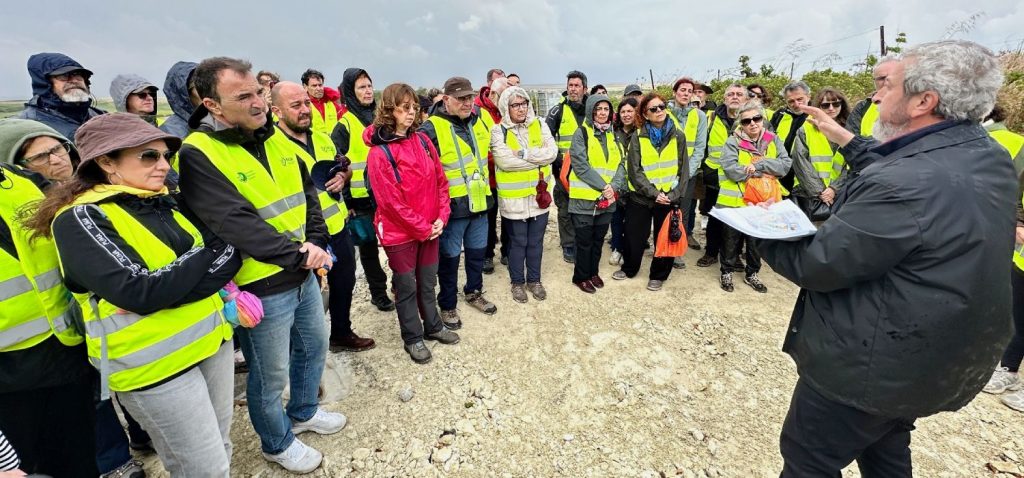
The activity, held in Trebujena and Sanlúcar de Barrameda, explored the role of albariza soils in the production of traditional country wines from the Cádiz countryside
The University of Cádiz has once again taken part in the celebration of Geolodía, the major annual geological outreach event held simultaneously in different Spanish provinces with the aim of bringing geology closer to the public. In the province of Cádiz, the 2026 edition took place last Saturday under the title Geology and Country Wines on Albariza Soils of the Cádiz Countryside, an initiative focused on the relationship between the geological substrate of the region and the unique characteristics of its wines.
The activity was organised by the Spanish Geological Society (SGE) and the Department of Earth Sciences at the University of Cádiz, combining scientific outreach, natural heritage and wine-making tradition through a route developed in the western area of the Cádiz countryside, around Trebujena, Sanlúcar de Barrameda and the banks of the Guadalquivir River. The Cádiz event was coordinated by a team of 15 people led by Salvador Domínguez Bella and Víctor Palacios Macías, professors at UCA’s Faculty of Sciences.
The itinerary allowed participants to learn first-hand about the geological characteristics of the so-called moronitas or albarizas, soils with very specific mineralogical, palaeontological and textural properties that play a key role in vineyard development and in the organoleptic characteristics of the wines produced in this part of the province.
During the event, attendees were able to gain a deeper understanding of the geological origin of these materials and the way in which the nature of the terrain influences both vine cultivation and the final properties of the wine. The activity also highlighted the close relationship between landscape, geology and economic activity, especially in a territory where wine-making traditions date back to Roman times.
The programme included field excursions to different geological sites in the area, as well as a guided tasting of country wines produced from vineyards located on different types of albariza soils. Participants also visited a traditional winery in Trebujena, where they learned about the wine-making process and tasted wines produced in different vineyard estates across the Cádiz countryside.
The initiative forms part of Geolodía 2026, a scientific outreach project that this year organised free geological routes in all 50 Spanish provinces, as well as activities in Andorra, Mexico and Uruguay, and cross-border routes with Portugal and France.
Geolodía aims to demonstrate that geology is not a discipline confined to academia or laboratories, but rather a science closely connected to many aspects of everyday life. In this regard, the activity held in Cádiz enabled the public to engage with scientific concepts related to soil formation, landscape evolution and the influence of geological features on economic and cultural activities deeply rooted in the province.
The organisation of this event was made possible thanks to the coordination of the Spanish Geological Society and the support of organisations such as the Spanish Foundation for Science and Technology (FECYT) of the Ministry of Science, Innovation and Universities, the IGME-CSIC and the International Association of Sedimentologists, together with other collaborating institutions and bodies.