

“The University of Cádiz Establishes Itself as a National and European Benchmark Through the SEA‑EU Alliance” 20 February 2026
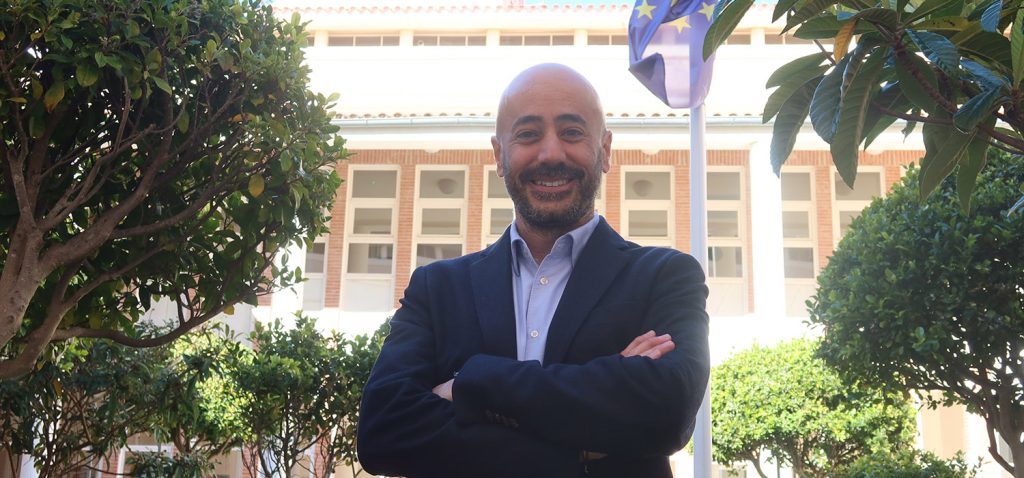
The University of Cádiz (UCA) has consolidated its positioning within the European higher education ecosystem. Being selected as the host of the second national meeting of the Spanish Universities in European Universities network (UEUE) and the recent election of Fernando Pérez Peña as Vice-President of FOREU4ALL reinforce UCA’s role in the European Universities Initiative funded by the European Commission through the Erasmus+ programme.
UCA has been selected to organize the second national UEUE meeting. What does it mean for the institution to be chosen as the host of this forum?
The UEUE forum integrates all Spanish universities that participate in European alliances funded by the European Commission through the Erasmus+ programme. Currently there are 73 alliances within the European Universities Initiative.
The organisation of this second national meeting was decided among three candidacies: the University of Seville (Ulysseus alliance), the University of Zaragoza (UNITA alliance), and the University of Cádiz with its SEA-EU alliance. After the Executive Committee of UEUE met, Cádiz was chosen as the host city.
For UCA, this represents clear support for our internationalisation strategy and positions us as a reference within the Spanish university system in European alliances. It also allows us to showcase our organisational and logistical capabilities and the work developed within the alliance over the past six years.
“The forum not only brings together universities: students, academic and research staff, technical personnel, political actors, and territorial agents also participate. The idea is to integrate the entire ecosystem that surrounds European alliances.”
Can this designation also be interpreted as recognition of the internationalisation model that UCA has been developing?
Yes. The recognition is not limited to hosting the UEUE forum. Recently, the Forum of Social Councils of Public Universities of Andalusia awarded UCA a prize for the internationalisation milestones achieved by leading the SEA-EU alliance.
Other universities are beginning to see SEA-EU as a reference model. With the launch of international joint degrees, institutions such as the University of Alcalá have visited to learn about UCA’s internal management and coordination practices with alliance partners.
What impact can this forum have on cooperation with other Spanish universities and on the consolidation of strategic alliances in Europe?
Hosting it in Cádiz allows us to bring the reality of European alliances closer to the university community. It is essential that students, academic staff, and technical staff understand what SEA-EU is — a network of nine universities and part of a much broader European ecosystem.
The forum will also be a space to share best practices and involve the whole community, reinforcing both strategic and institutional cooperation.
You have been elected Vice-President of FOREU4ALL. What does this appointment represent for UCA?
FOREU4ALL is a community of practice funded by the European Commission that unites the 73 European alliances — representing more than 500 higher education institutions. Its objective is to act as a permanent interlocutor with the European Commission.
The leadership structure consists of a presidency — held by Beatrix Busse — and two vice-presidencies, one of which I hold. This appointment places UCA at the core of dialogue with the European Commission, allowing us to participate in policy discussions, anticipate scenarios, and defend strategic interests.
“It is a process comparable, in terms of integration, to what the creation of the euro represented.”
What will your main responsibilities be and what priorities should FOREU4ALL address now?
The vice-presidency involves supporting the presidency and maintaining continuous dialogue with the European Commission. FOREU4ALL has 20 working groups addressing areas such as student participation, funding, territorial impact, governance, and legal entities. Our function is to collect the work of these groups and articulate it with European policies to consolidate the European Universities model.
The initiative represents a structural change, integrating universities under shared governance, legal frameworks, and academic cooperation.
How has the role of UCA evolved since the creation of SEA-EU?
SEA-EU began in 2019 with six partners and Erasmus+ funding. In 2023, three new universities joined, bringing the total to nine partners, with funding extended through 2026.
The alliance now acts as a structural model beyond marine-maritime fields, involving joint degrees such as:
- Bachelor’s in Sustainable Blue Economy (SeaBluE)
- Master’s in Port Management and Logistics (MIPMAL) — coordinated by UCA
- Master’s in Sustainable Management of Organisations (STORM) — coordinated by the University of Brest
Beyond the institutional level, what real impact does SEA-EU have on students, academic staff, and technical staff?
The model combines top-down and bottom-up approaches, engaging the whole community through participation in international programs, Staff Weeks, Blended Intensive Programmes (BIPs), job shadowing, and student-led projects.
These initiatives improve multicultural and multilingual competencies with tangible impact across the university.
Strategic impact on territorial development and Cádiz’s international projection
SEA-EU includes cities, port authorities, companies, NGOs, and research centres, linking internationalisation with territorial development. UCA’s collaboration with the Bay of Algeciras Port Authority has resulted in joint microcredentials, directly impacting professional training in the maritime sector.
“Internationalisation is no longer the exclusive responsibility of a single vice-rectorate: it is a transversal strategy that affects the entire university.”
Final message
SEA-EU has reached a level of maturity that makes it a central axis of UCA’s internationalisation strategy. It is an advanced model of academic and territorial cooperation transforming the institution and its environment.