

The University of Cádiz brings together the European scientific community at EuroMarine Open Science Day 2026 19 March 2026
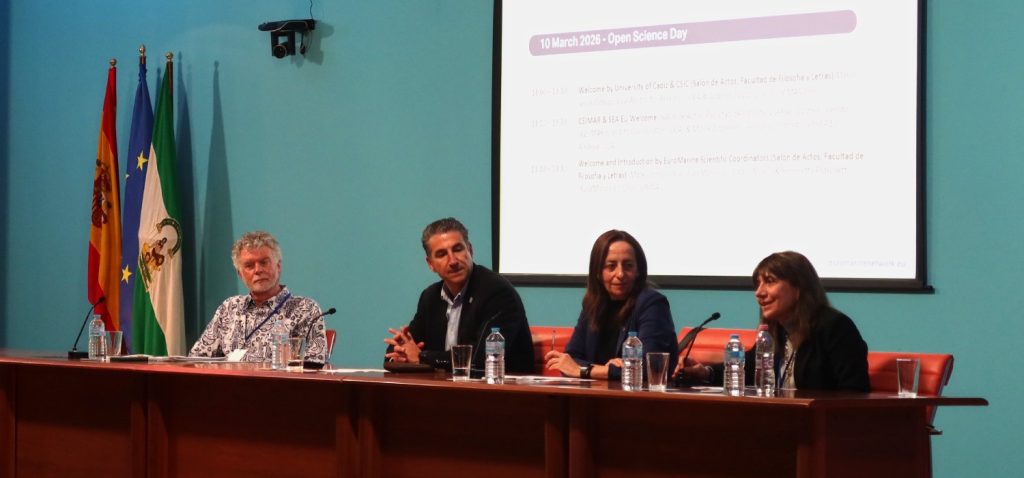
UCA is hosting this international meeting until Thursday, focused on advances in marine sciences and the challenges facing the global ocean
The University of Cádiz is hosting, from this Tuesday until next Thursday, the EuroMarine Open Science Day 2026, an international meeting that brings together researchers from different European institutions to share scientific advances and strengthen cooperation in the field of marine sciences. The event, presented in the Aula Magna of the Faculty of Philosophy and Letters and organised in collaboration with the Spanish National Research Council (CSIC), further consolidates the city of Cádiz as a meeting point for European marine research.
EuroMarine is the largest European network dedicated to marine research, with a scope ranging from the study of genes to the analysis of ocean ecosystems. Over the course of three days, the international scientific community is sharing research results, experiences and ongoing projects in a context shaped by the major global challenges facing the oceans, such as climate change, biodiversity loss and new pressures arising from human activity.
The institutional opening was attended by the Vice-Rector for Research and Knowledge Transfer at the University of Cádiz, María Jesús Ortega; the scientific coordinator of CEI·MAR, Carmen Garrido; and the Vice-Rector for Internationalisation, Marcela Iglesias, who welcomed participants on behalf of the organising and collaborating institutions. They were joined at the opening session by Simonetta Fraschetti and Mark John Costello, co-directors of the EuroMarine network, and Antonio Tovar, researcher at ICMAN-CSIC.
In her speech, María Jesús Ortega highlighted the importance of the EuroMarine network as a platform for scientific collaboration at a European level, underlining the growth experienced by this research community over the past decade. In this regard, she noted that the network brings together more than fifty institutions and has mobilised significant resources to support scientific projects and early-career researchers, contributing to the consolidation of a particularly dynamic ecosystem of cooperation in marine research.
For her part, Carmen Garrido emphasised the ability of this event to bring together specialists from different disciplines and backgrounds to address major scientific challenges related to the ocean. She also highlighted the role of initiatives such as EuroMarine in fostering new ideas and encouraging exchange between established researchers and early-career scientists, underlining their importance within the framework of the United Nations Decade of Ocean Science for Sustainable Development.
Finally, the Vice-Rector for Internationalisation, Marcela Iglesias, stressed the international dimension of the event and its contribution to strengthening scientific cooperation among European universities and research centres. In this sense, she recalled that the challenges affecting the oceans are global and require responses based on collaboration, knowledge exchange and the development of joint projects that integrate research, innovation and education.
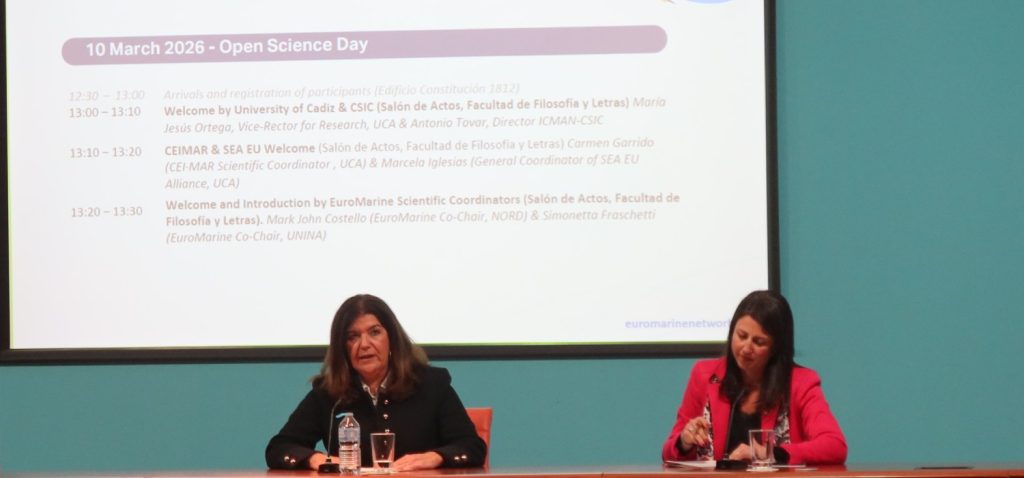
Lectures and networking sessions
The scientific programme of the meeting includes a wide range of keynote lectures, scientific presentations and discussion sessions focused on some of the most relevant topics in contemporary marine research. These include issues such as blue carbon and marine ecosystem restoration, the monitoring of invasive species, the study of deep ocean processes, and the analysis of biodiversity and ecosystem services in coastal areas.
Among the scheduled contributions are presentations such as the one on the role of seagrass meadows in carbon capture, delivered by University of Cádiz professor Juanjo Vergara, and a lecture on the Strait of Gibraltar as an indicator of climate change in the ocean, given by CSIC researcher Emma Huertas. Other experts, such as Ronnie Glud (SDU), will explore life in the deep sea, while discussions will also address innovations in Digital Twins and marine ecotoxicology.
To strengthen the connection between science, society and policy, two strategic workshops will be held: the first, focusing on links with social sciences, led by Emma McKinley (Cardiff University), and the second on understanding the policy landscape, delivered by Dennis Naughten (Innosphere).
In addition to the scientific sessions, the meeting includes spaces for exchange among researchers, such as a poster session and networking activities aimed at fostering new collaborations. Furthermore, on 12 March, a hybrid matchmaking session will be held to promote the creation of international scientific consortia for future Horizon Europe calls.
The event will conclude with the meeting of the EuroMarine General Assembly and Steering Committee, where representatives of participating institutions will review the achievements of recent years and define the priorities that will guide scientific activities in the coming decade.