

The UCA conducts the first high-resolution GPS tracking of the transcontinental migration of the Kentish plover in southern Europe 5 April 2026
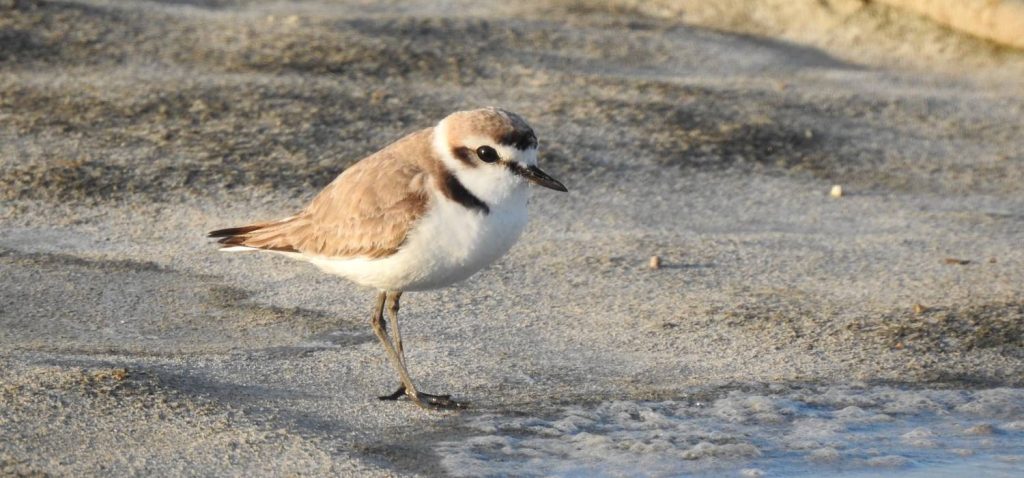
The study, published in the journal Ardeola, reconstructs the journey of a breeding female tagged in the Bay of Cádiz to its wintering grounds in Mauritania
A research team from the Department of Biology at the University of Cádiz has successfully tracked with high precision the complete migration of a Kentish plover (Anarhynchus alexandrinus), a small wading bird commonly found in beaches, salt marshes and coastal wetlands. The study, published in the scientific journal Ardeola, has provided the first high-resolution GPS record of a full transcontinental migration in a breeding female from southern Europe, tagged in the Bay of Cádiz.
To understand the significance of this work, it should be noted that the Kentish plover is classified as endangered in the Spanish Red List of Birds. In this context, the province of Cádiz—due to its combination of beaches, salt marshes and coastal wetlands—represents one of the most important breeding areas for the species in Europe, highlighting the relevance of studies that improve knowledge of its movements and ecological needs throughout the annual cycle.
In addition, the Kentish plover weighs less than 45 grams, which has historically made tracking it with localisation technology particularly challenging. In this study, researchers have used an ultralight GPS device weighing just 1.9 grams, attached באמצעות a harness, allowing them to reconstruct a detailed “road map” of its journey without observing any adverse effects on the monitored individual.
The data show that, after the breeding season, the bird travelled approximately 2,500 kilometres in around seven days from Cádiz to its wintering area in the Diawling National Park, in southwestern Mauritania, where it remained for 162 days. Although the study focuses on a single individual and therefore provides preliminary results, the tracking offers valuable insights into the species’ migratory performance and the key sites it uses throughout its annual cycle.
One of the most striking findings of the study is that the bird does not follow exactly the same route on its migratory journeys, instead displaying a strategy known as “loop migration”. In autumn, this individual followed a mainly coastal route, with longer stopovers for rest and feeding. In contrast, during spring migration, it chose a more inland route, flew at higher altitudes and reached greater speeds, completing the return journey in a similar timeframe but in a more direct manner.
The tracking also reveals a significant change in how the bird uses space depending on the time of year. During the breeding period in Cádiz, the individual moved within a relatively small territory of around 90 hectares. However, during the wintering period in Africa, its home range exceeded 20,000 hectares, “suggesting that, in winter, it needs to explore large wetland areas to find food and resources,” as explained by the researchers in the study.
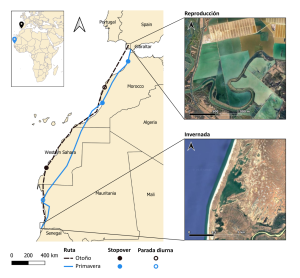
With all this, it is important to note that the work carried out by this research team has highlighted that the survival of this species depends on an international network of wetlands, several of which are recognised as “Ramsar sites”, acting as stopover and refuelling areas during migration. Identifying these key locations and preserving their connectivity is essential to design effective conservation measures that go beyond the breeding season and also address migration and wintering periods.
The article First GPS tracking of transcontinental migration in a South European Kentish Plover has been authored by Yana Korneeva, Andrés de la Cruz, Nuria Martín, Gonzalo Muñoz, Alberto Álvarez, Alejandro Pérez-Hurtado and Macarena Castro, all of them affiliated with the Marine Research Institute (INMAR).
Bibliographic reference: Yana Korneeva, Andrés De La Cruz, Nuria Martín, Gonzalo Muñoz, Alberto Álvarez, Alejandro Pérez-Hurtado, and Macarena Castro (2025): First GPS Tracking of Transcontinental Migration in a South European Kentish Plover Anarhynchus alexandrinus, Ardeola 73(1), 149–162. https://doi.org/10.13157/arla.73.1.2026.sc1