

“The Key to a Successful University Entrance Examination Is That All 8,000 People Involved Know Their Role and the Rules of the Game” 9 June 2026
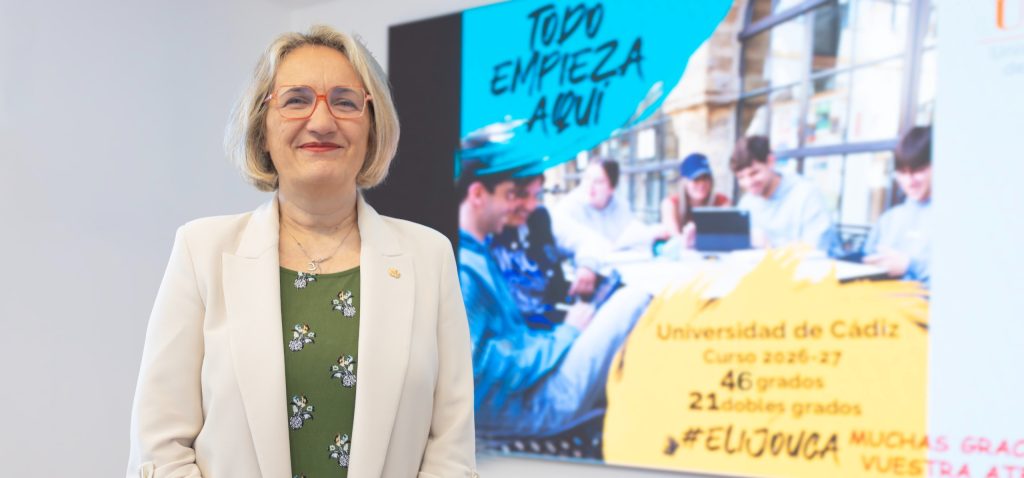
Nuria Campos, Vice-Rector for Students, reflects on the major organisational and logistical challenge of coordinating Andalusia’s 2026 University Entrance Examination (PAU).
In English-speaking countries, there is a well-known saying: No news is good news. In the case of the 2026 University Entrance Examination (PAU), the absence of major incidents was perhaps the best possible headline. This year, the University of Cádiz not only organised the examination across its own campuses but also coordinated the process for the entire Andalusian University District. Vice-Rector for Students Nuria Campos discusses the work behind the scenes that ensured the success of the examination in a context marked by regulatory changes, technological challenges and evolving approaches to teaching and assessment.
This year’s PAU was particularly significant for the University of Cádiz. What did it represent for the institution?
This year’s PAU was an extraordinary challenge because, in addition to our usual responsibilities, we were entrusted with coordinating the process across Andalusia. It required a considerable additional effort, but it was highly rewarding because everything went very smoothly. All Andalusian universities are very satisfied with the outcome.
It was an intense but unique experience, and the overall assessment could not be more positive. The team within the Vice-Rectorate for Students, especially the Directorate-General for Access and Guidance, worked with remarkable dedication and coordination. I would like to thank everyone involved for their commitment during both the examination period and the months of preparation beforehand.
Around 8,000 people—including students, academic staff and support personnel—were involved in the process. What is the secret to making such a large operation work?
One of the key factors is that everyone involved knows exactly what their role is and understands the rules of the process.
Secondary schools do an excellent job preparing students, and students themselves are fully aware of the importance of these examinations. At the same time, everyone involved in organising the PAU understands that the University’s reputation is also at stake.
Our primary objective is to ensure that everything is conducted correctly because this is a crucial moment in students’ academic journeys. Any problem can have a direct impact on their future opportunities. That is why everyone—from examination board presidents and secretaries to invigilators and support staff—shares the same priority: helping students and ensuring the process runs smoothly.
“All UCA staff involved are fully aware of their responsibilities, and the key word throughout the process is ‘support’.”
What has the University of Cádiz learned from this experience?
It has been an invaluable learning process that reinforced the importance of teamwork.
Coordinating internally within a university is one thing; reaching agreements and building consensus among all Andalusian universities is something entirely different. Organising the PAU is not simply a matter of logistics. It involves making decisions, proposing solutions and ensuring that no institution or group of students is disadvantaged.
There is also a significant technological dimension, alongside the physical demands that inevitably arise at the end of the academic year. Every year we review what worked well, identify areas for improvement and make adjustments. Nothing can be improvised because students need complete clarity about how the examination process will unfold.
One of the major concerns surrounding university entrance examinations is academic integrity. How did the coordination team address this issue?
Preventing misconduct remains a challenge in several respects.
This year, we adopted a dual approach. On the one hand, we incorporated technological measures, including detection systems. On the other, we focused on more traditional forms of misconduct, particularly the unauthorised circulation of examination papers.
In fact, one of our main concerns was preventing paper-based copying. All Andalusian public universities agreed that examination papers would not leave the examination room during the first ninety minutes of each test. This represented a significant change from previous practice and helped strengthen the integrity of the process.
“One of the main concerns in the coordination process continues to be preventing traditional forms of copying.”
There has been considerable debate in recent years about university entrance examinations. Do you think the current model remains effective?
Any process can be improved, even when it works well.
Although the PAU may appear largely unchanged, gradual improvements have been introduced over time. However, we must adopt a broader perspective. Students are not simply applying to one university or one region; they should be able to move freely across Spain.
This means we need examination systems that are as harmonised as possible across the country. Significant progress has already been made. For example, examination dates are now coordinated nationwide, something that was not the case a few years ago.
The challenge is that any change requires consensus among many universities and stakeholders, as well as adjustments to regulations. Progress is gradual, but it is moving in the right direction.
The enrolment period is about to begin. What makes the University of Cádiz different from other universities?
Many things, but perhaps the most important is that the University of Cádiz combines academic excellence with a genuinely close and supportive environment.
Here, students are not simply numbers. Our multi-campus structure, the diversity of our degree programmes and the size of our classes allow us to maintain a more personal relationship with students.
We also have distinctive strengths. One of them is our strong connection to the sea. As coordinator of the European University of the Seas alliance (SEA-EU), we are developing international programmes and strengthening our position in areas related to the blue economy. This maritime identity is one of the defining characteristics of our institution and a source of international recognition.
“Without compromising on excellence, the University of Cádiz has established itself as a university that is close to its students.”
What would you say to a prospective student who is considering where to study next year?
I would tell them that at the University of Cádiz they will find four highly accessible campuses, a welcoming environment and lecturers who are approachable and committed to student success.
They will also find an active and supportive Student Council, extensive opportunities for mobility through programmes such as Erasmus and SICUE, and an increasingly international outlook.
Above all, they will discover a university that is deeply connected to its region and its communities while maintaining a global perspective. We offer students the opportunity to grow academically and personally in a unique environment.
I am convinced that anyone who chooses the University of Cádiz will find an enriching experience and will not be disappointed.