

The IN-EMHis organises the 2nd CLARIAH-AND Workshops on data management in Digital Humanities 30 January 2026
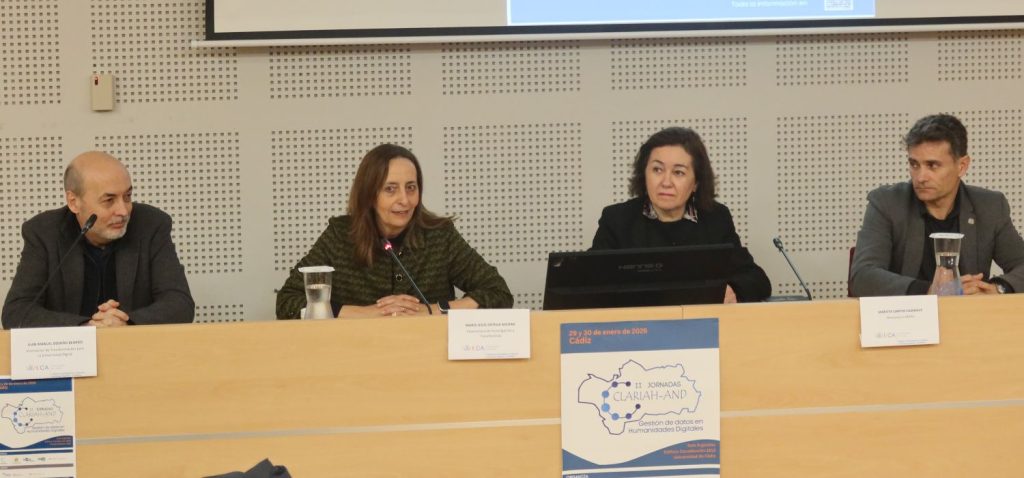
The meeting is being held at the Constitución 1812 Building and has addressed the need to integrate digital ecosystems, open science and humanistic studies.
The University of Cádiz has hosted on Thursday and Friday the 2nd CLARIAH-AND Workshops: Data Management in Digital Humanities, an academic meeting that has brought together researchers and professionals from the fields of Humanities, Social Sciences and heritage management to reflect on the challenges and opportunities posed by working with data in digital environments. The workshops have been organised by the Institute for Research in Hispanic World Studies (IN-EMHis), in collaboration with the CLARIAH-AND initiative.
The programme began on Thursday afternoon with the opening ceremony, attended by the Vice-Rector for Research and Knowledge Transfer, María Jesús Ortega; the Vice-Rector for Digital Transformation, Juan Manuel Dodero; the CLARIAH-AND Coordinator, Arturo Montejo; and the Director of the IN-EMHis, Marieta Cantos. Ortega highlighted that the workshops “clearly represent the essence of new systems of research, evaluation and knowledge dissemination”, based on a transversal and collaborative working method. She also underlined the commitment of the University of Cádiz to open science, stating that “we believe it represents an opportunity to improve the quality of science”. Dodero, for his part, emphasised the interdisciplinary nature of the workshops and the need for joint work between technical areas and humanistic studies. He also thanked attendees for the effort made to take part in the event despite the adverse weather conditions.
Arturo Montejo highlighted how digital environments have transformed the way research is processed and conducted, and how they constitute a unique field of study due to their potential applications in both education and teaching. Marieta Cantos, who echoed the appreciation expressed to participants for their efforts to reach the Constitución 1812 Building and attend the workshops, stressed the importance of the humanities “at a time when critical thinking is more necessary than ever to respond to this new culture of narratives and fake news, using the tools of digital technology”.
Following the opening session, the keynote lecture was delivered by Françoise Gouzi, representative of the European research infrastructure DARIAH (Digital Research Infrastructure for the Arts and Humanities). In her presentation, she highlighted the importance of the FAIR principles as an essential framework for responsible research data management. The researcher emphasised the value of open repositories and reviewed some of the existing Open Access systems, particularly those linked to the field of Humanities.
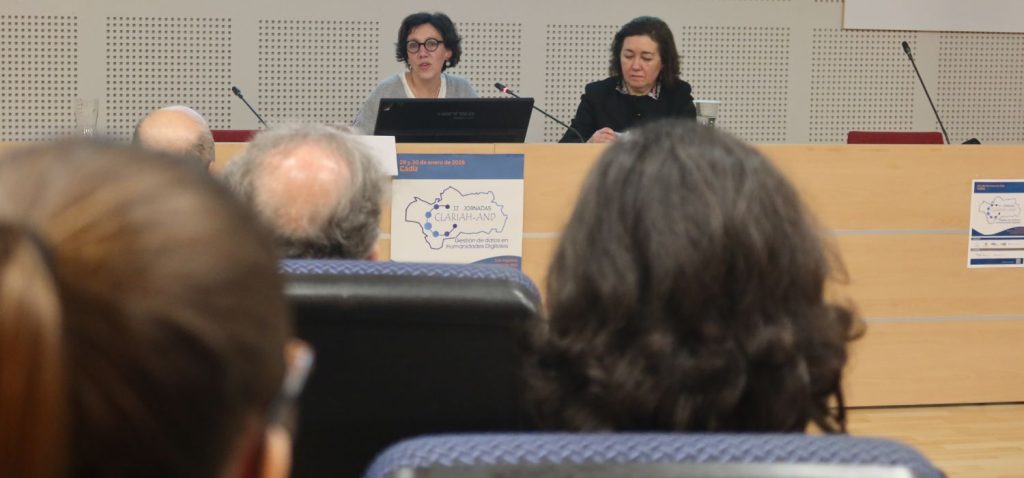
Subsequently, Francisco Javier Carreras Riudavets, from the University Institute for Textual Analysis and Applications at the University of Las Palmas de Gran Canaria and Coordinator of CLARIAH Canarias, presented a range of textual applications developed within the framework of IA-TEXT. This was followed by Alfonso Ureña López, from the Intelligent Information Access Systems Research Group (SINAI) at the University of Jaén and Coordinator of CLARIAH-AND, who addressed the ALIA project and the use of large language models for Spanish and co-official languages.
Thursday’s programme concluded with a round table focused on the GLAM sector (galleries, libraries, archives and museums), which brought together representatives from various institutions. Participants included Gregorio Rodríguez, Director of IATEXT at the ULPGC; José Luis Zafra, Head of Systems at the Andalusian Institute of Historical Heritage; Jesús Fernández García, Director of the Library and Archive of the University of Cádiz; and Ana María Chacón, from the Provincial Archive of Córdoba. This dialogue session enabled the sharing of experiences related to data management and heritage digitisation from different institutional perspectives.
Friday programme
On Friday 30, the programme has continued with the presentation of projects linked to the CLARIAH-AND Node, followed by a series of practical workshops. Arturo Montejo, Coordinator of CLARIAH-AND and national CLARIN expert at the University of Jaén, has delivered a workshop focused on access to the CLARIN and DARIAH infrastructures. Subsequently, Rocío Ortuño, Director of the Laboratory for Innovation in Digital Humanities at the UNED, has led a workshop on database design using the HEURIST tool.
The day has also included a poster session, which has encouraged direct exchange among researchers, as well as the lecture Non-invasive technologies for the study of heritage, delivered by Lázaro Lagóstena, from the University of Cádiz. The meeting concludes with a closing session in which reflections and proposals for future editions have been shared.
The 2nd CLARIAH-AND Workshops have taken place within the framework of the CLARIAH-AND initiative, whose aim is to promote research in Andalusia through participation in the European research infrastructures CLARIN and DARIAH. Through this consortium, the goal is to support the integration of Andalusian research groups into these international networks, strengthen their presence within the European Research Area, and facilitate greater participation in European projects and programmes.
The event has helped to consolidate the CLARIAH-AND Workshops as a benchmark forum in Andalusia for professionals working in the fields of Digital Humanities, Open Science and cultural heritage management. Over the course of the two sessions, topics related to data interoperability, the FAIR principles, the use of European research infrastructures and the application of digital technologies to the study of historical and cultural heritage have been addressed.