

The Faculty of Economics and Business Studies hosts the Poster Exhibition on Economics, SDGs and Marketing 6.0 11 December 2025
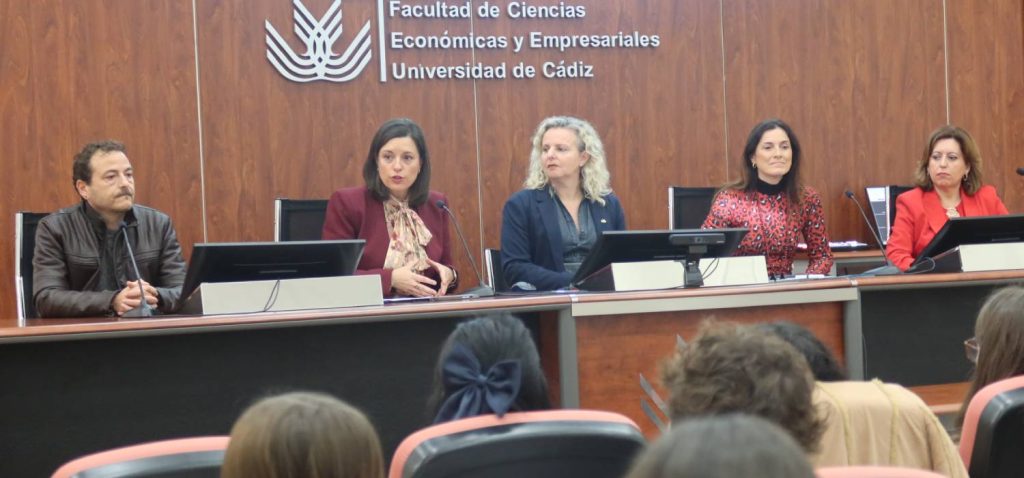
The Mayor of San Fernando and Cádiz City Council’s Councillor for Housing and Sustainability support students at an exhibition showcasing the socio-economic features and SDGs of each municipality in the province
The Faculty of Economics and Business Studies of the University of Cádiz hosted on Thursday morning the Poster Exhibition on Economics, SDGs and Marketing 6.0, an outreach and training event that brought together students, academic staff and institutional representatives to reflect on sustainable development and its impact on the socio-economic fabric of the province. The event was attended by the Dean of the Faculty, Susana Fernández Pérez de la Lastra; the UCA Director General for Students, Federico Hervías; the Mayor of San Fernando, Patricia Cavada; the Councillor for Housing of Cádiz City Council, Ana Sanjuán; and Professor María Teresa Fernández-Alles, Director of the Department of Marketing and Communication and promoter of the initiative.
One of the central pillars of the exhibition was the display of posters on economics, SDGs and marketing in the province of Cádiz, produced by Faculty students. Each group worked on a different municipality, analysing in a visual and creative way how each locality integrates the Sustainable Development Goals (SDGs) into its public policies and how it designs strategies to boost its local economy, incorporating SDG-oriented proposals through the Marketing 6.0 approach. Installed in the entrance hall of the Faculty, the exhibition offered a clear view of the territorial diversity of the province and the different ways in which local councils integrate sustainability, innovation and strategic communication into their development plans.
The event was marked by a high level of student participation, with the exhibition space filled throughout the morning. Students accompanied the authorities on a final tour of the posters, sharing insights into the creative process, the challenges encountered and the tools used—including artificial intelligence as support for design and conceptualisation. This exchange resulted in a close, practical and enriching conclusion, fully aligned with the educational and outreach-oriented spirit of the exhibition.
During the opening session, the Mayor of San Fernando, Patricia Cavada, highlighted the relevance of marketing and communication as tools capable of raising awareness and persuading citizens. She stressed the need to develop strategies that clearly convey what is being done and why, particularly in the field of sustainability, noting that political leaders have a responsibility to contribute to social progress “with respect for sustainable development”. Her remarks underscored the importance of institutional responsibility in promoting a civic culture aligned with the SDGs.
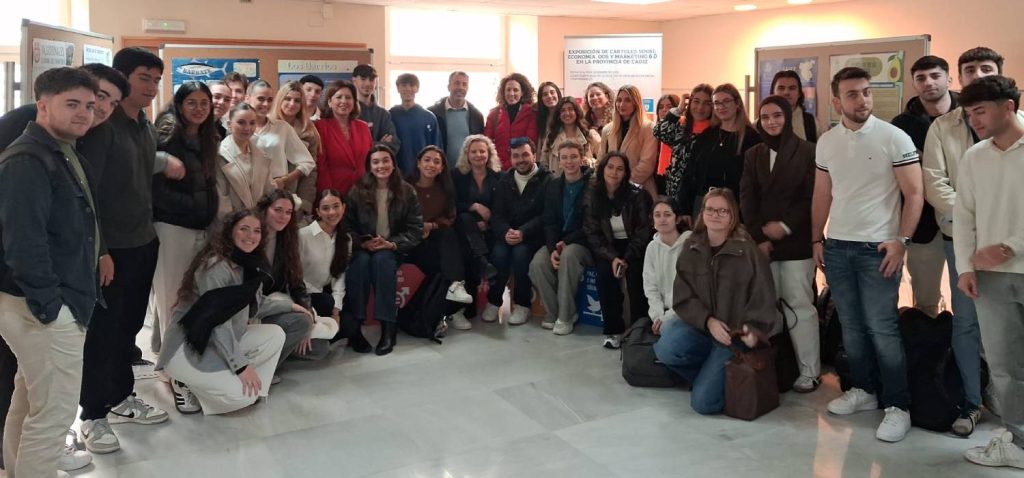
For her part, Ana Sanjuán, Councillor for Housing and Sustainability at Cádiz City Council, highlighted the work carried out by the students over recent months and valued the support her department has been able to provide throughout the process. She noted that the SDG dimension is fundamental in municipal planning, and that the posters presented offer “a visual perspective on reality” that helps to understand how the transversal nature of the SDGs makes it possible to transform the environment and guide local policies towards criteria of social justice and sustainability.
The Director General for Students, Federico Hervías, used his remarks to challenge a recurring perception that universities operate with little connection to their immediate surroundings. In this regard, he stated that initiatives such as this Exhibition demonstrate precisely the opposite: an active, engaged and approachable university that encourages student participation and fosters their direct connection with the socio-economic realities of the province.
Professor María Teresa Fernández-Alles, promoter of the Exhibition, gave part of her address to two students, Cecilia Sibón and Javier Caneda, who explained how creativity and innovation have been key elements in the development of their projects. Both students highlighted the potential of artificial intelligence as a support tool, provided it is used in a critical and responsible manner. Fernández-Alles emphasised that the teaching and learning process must be grounded in a genuine connection with students, stating that “rigid formulas do not work if the aim is to connect with students”. Her message reinforced the importance of dynamic, participatory methodologies adapted to a constantly evolving digital context.
The Dean of the Faculty, Susana Fernández, brought the round of speeches to a close by underscoring the value and capabilities of the students, whom she described as a well-prepared, committed and engaged generation. She stressed that the posters on display constitute high-quality material that clearly reflects both the talent and the sense of responsibility shown by students when addressing issues related to sustainability and the economic reality of the territory.
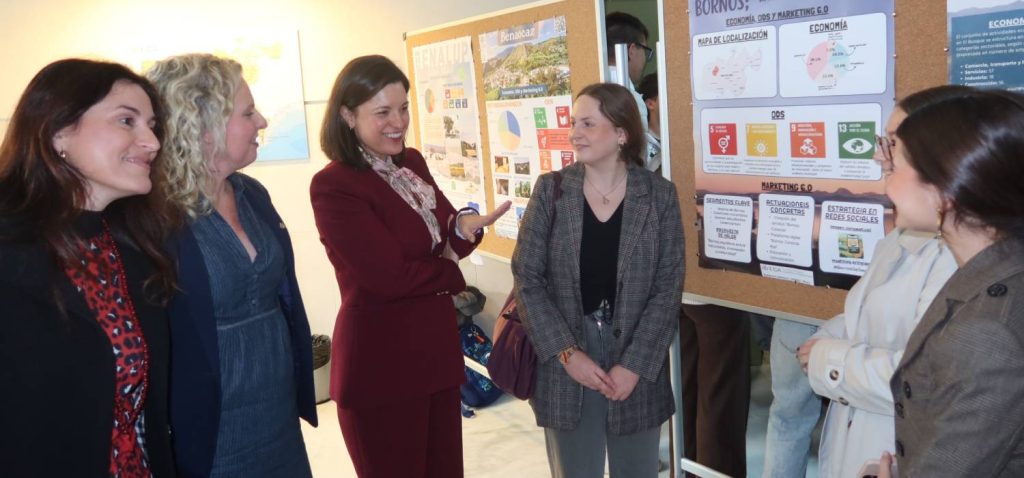
Following the institutional addresses, the authorities toured the exhibition accompanied by the students who developed the projects. This final exchange made it possible to further explore the educational value of the initiative and the challenges faced during its development, consolidating the Poster Exhibition on Economics, SDGs and Marketing 6.0 as a training space that brings together learning, creativity and social commitment.