

The Faculty of Arts and Humanities hosts the 24th AETER Conference on Terminology and Lexicography 6 November 2025
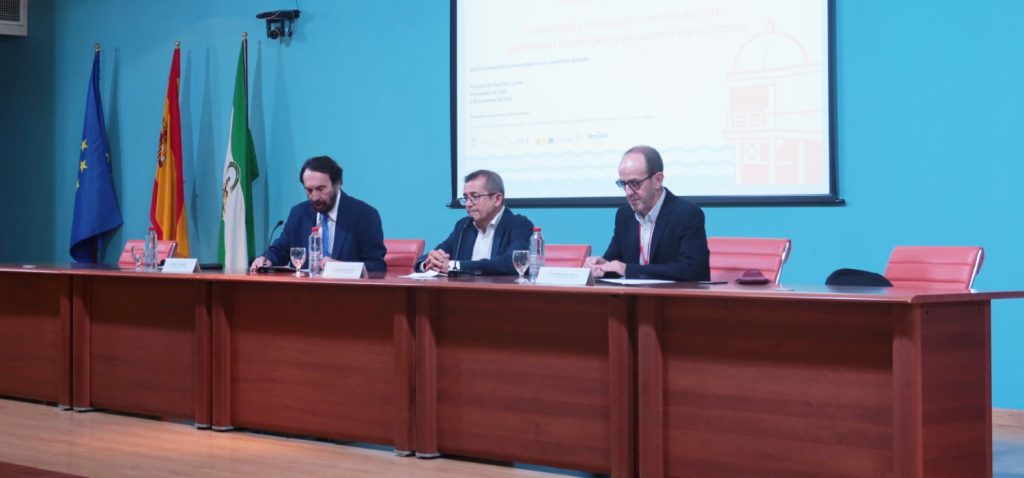
The national meeting, which has brought together nearly 200 researchers at the University of Cádiz, was inaugurated by Dean Antonio Serrano and the director of the ILA, Miguel Casas
The University of Cádiz is hosting the 24th Conference of the Spanish Terminology Association (AETER) this week, which was inaugurated on Thursday at the Faculty of Arts and Humanities. Under the title Terminology and Lexicography: Digital Resources, Technological Platforms and Specialized Dictionaries, the event brought together specialists in terminology, lexicography, and language technologies, and served as a forum for reflection on the new challenges both disciplines face in the digital age.
The opening session, attended by nearly 200 participants, took place in the Aula Magna of the Faculty and was led by the Dean, Antonio Serrano Cueto; the Director of the Institute of Applied Linguistics (ILA) at the University of Cádiz, Miguel Casas; and the President of AETER, Joaquín García Palacios. All three speakers highlighted the relevance of terminology and lexicography in the digital era and praised the role of the UCA as host institution for this academic event.
The Dean expressed his pride in welcoming the conference “as both Dean and a philologist,” emphasizing that the passion for exploring the meaning, use, and context of words is something that artificial intelligence will never be able to replicate. Miguel Casas focused on the work carried out at the ILA and how its researchers have helped elevate the standing of Andalusian terminology and lexicography studies in Spain. Finally, García Palacios thanked the UCA for its organizational efforts and affirmed that the field is “a commitment to the future.”
The opening lecture was delivered by researcher Gloria Guerrero from the University of Málaga. In her talk, Innovations and Challenges in Terminology and Lexicography: Mutual Contributions and Shared Boundaries, she explored the differing approaches of terminology and lexicography, and how both fields are deeply interconnected within academic research.
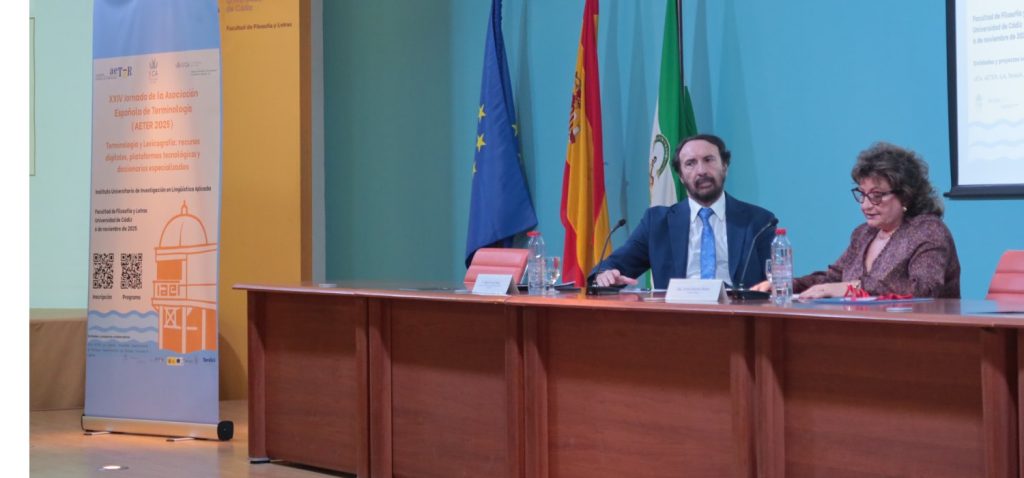
Next, the roundtable Digital Resources, Technological Platforms, and Specialized Dictionaries began, moderated by Professor María Araceli Losey (UCA) and featuring Joaquín García Palacios (University of Salamanca), Isabel Santamaría (University of Alicante), Mercedes Roldán (University of Jaén), and Sara Gómez Díaz and Alba Macías (UCA). This session explored the challenges related to access, design, and management of electronic terminological resources in specialized contexts.
The conference continued with a session of research papers held at the Constitución 1812 Building. In the afternoon, a poster exhibition took place in the central hall of the Faculty, showcasing recent projects and providing opportunities for networking with authors. The second roundtable, scheduled from 5:00 to 6:15 p.m., was titled Current Projects in the Field of Terminology, featuring contributions from Miguel Casas Gómez (UCA), Rosa Estopà Bagot (Pompeu Fabra University), and Elena Montiel (Polytechnic University of Madrid), and moderated by María Teresa Cabré (Pompeu Fabra University).
The choice of Cádiz as the venue carries both symbolic and strategic significance, as 2025 marks several key anniversaries: thirty years since the launch of Linguistics studies at UCA, ten years of the Institute of Applied Linguistics (ILA), and the inaugural edition of the Master’s Degree in Language Sciences and their Applications, which includes a specialization in Language Technologies and Language Industries. This convergence places the University of Cádiz at the forefront of academic reflection on terminology, lexicography, and their digital transformation.
Key themes throughout the program included the methodological and technological challenges associated with specialized terminology (e.g., in fields such as aeronautics, olive oil production, maritime navigation, and the jewelry industry), the application of FAIR principles to terminological data (Findability, Accessibility, Interoperability, and Reusability), and the development of digital platforms and specialized dictionaries. Participants discussed how the disciplines of terminology and lexicography—traditionally tied to the analysis of specialized language—are evolving towards integration with language technologies, artificial intelligence, and complex digital resources.