

The ELECMI ICTS Renews Its Recognition in the 2025–2028 ICTS Map with the Participation of the University of Cádiz 19 January 2026
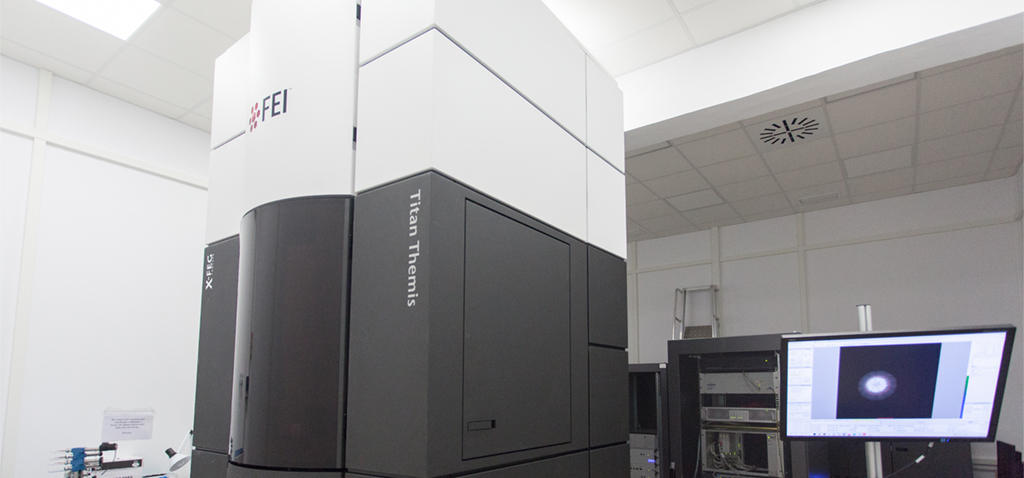
The DME-UCA node expands its capabilities with the new EnviroESCA system and stands out for combining in-situ experimentation at both nanoscopic (STEM) and macroscopic (NAP XPS) scales
The Integrated Infrastructure for Electronic Microscopy of Materials (ELECMI) has renewed its status as a Unique Scientific and Technical Infrastructure (ICTS) in the 2025–2028 ICTS Map, approved by the Council for Scientific, Technological and Innovation Policy (CPCTI).
It should be noted that ELECMI is a distributed ICTS made up of four infrastructures, including the Division of Electronic Microscopy of the University of Cádiz (DME-UCA), based at the Puerto Real Campus. As an ELECMI node, DME-UCA provides advanced scientific and technical services in electron microscopy, supported by unique equipment such as ultra-high-resolution transmission electron microscopes (UHR-TEM), including the TITAN Cubed THEMIS 60–300 UHR-TEM, the TALOS F200X, and the SCIOS2 dual-beam focused ion and electron microscope.
This suite of equipment has recently been expanded with a fourth addition: the Specs Environmental Electron Spectroscopy for Chemical Analysis (EnviroESCA) spectrometer, which enables the analysis of samples under near-ambient conditions, as well as the study of solid, liquid and gaseous samples. This new capability strengthens one of the node’s distinguishing features by enabling in-situ experimentation at the macroscopic scale (NAP XPS), complementing in-situ experimentation at the nanoscopic scale (STEM). As a result, DME-UCA is the only ELECMI node to integrate both scales within the same infrastructure.
In addition, the FEI Titan Themis 60–300 microscope at the DME-UCA node is double-corrected (probe and objective), enabling simultaneous analytical and structural studies with resolutions better than one ångström. Furthermore, within this ICTS, the UCA team is the only one equipped with a direct detection camera for in-situ experiments.
In line with the open-access model of ICTSs, these facilities may be used free of charge for up to 20% of the operating time of each piece of equipment to carry out projects by users whose proposals have been previously approved by the Access Committee of this distributed ICTS.