

“The convergence of Artificial Intelligence and Digital Humanities represents one of the key moments for academic research and cultural preservation” 30 January 2026
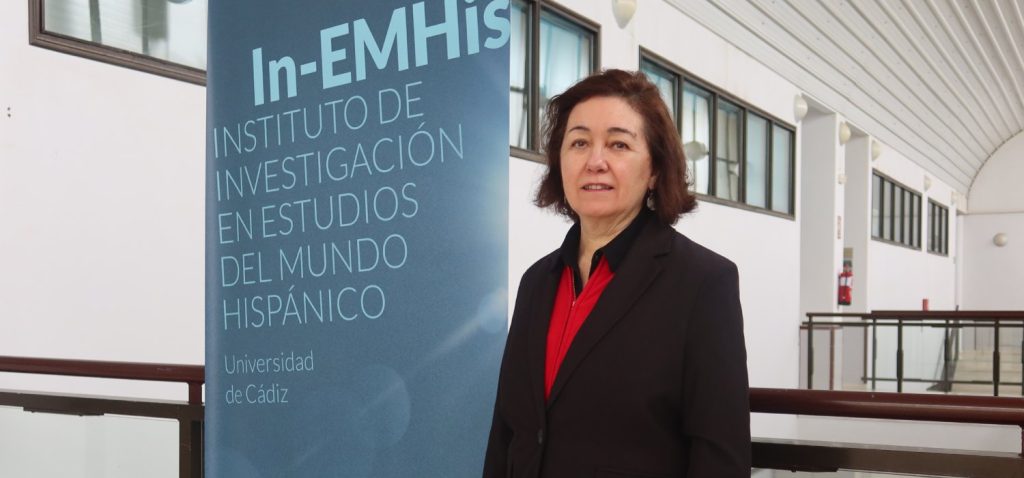
Marieta Cantos, Director of the Institute of Hispanic World Studies, analyses how new technologies are changing the approach to the humanities in the university environment
We are living through a historic moment, at a hinge point between an analogue world that is fading away and a digital one that is emerging with more questions than answers. Many of the keys to understanding this new scenario are not to be found in chips or virtual clouds, but in the texts and reflections of humanists who analysed the world around them guided by critical thinking and the infallible tool of the written word. The Institute for Research in Hispanic World Studies (IN-EMHis) of the University of Cádiz is one of those bastions of thought where the analysis of the convergence of spaces and times offers a broad perspective on who we are, based on who we once were. Its director, Professor Marieta Cantos, reflects in this interview on the activity of the IN-EMHis and outlines how the dynamic digital ecosystem has been integrated into the work carried out by its researchers.
What are the main lines of work of the Institute for Research in Hispanic World Studies (IN-EMHis)?
Our institute addresses several lines of research focused on the Hispanic World, ranging from popular culture and heritage to linguistic and literary studies, the history of political ideas (liberalism, democracy, heterodoxies), social history (gender, social movements), globalisation and international relations. In addition, from the institute’s management we have strongly committed to Digital Humanities as a means of advancing research and, above all, the transfer of results, which is materialised through HispanoLab.
Your research lines bring together work from very diverse fields. How does contact with such different areas enrich researchers?
Based on our previous experience as research groups, we have carried out a number of collaborative and multidisciplinary initiatives that have confirmed that this transversal approach —addressing history, literature, language, art and the culture of the Hispanic community— is the path that most enriches researchers and the transfer of their work to society. A good example of this was everything related to the Bicentenary of the Constitution of 1812. At that time, Cádiz was experiencing exceptional multicultural richness with a strong projection in Europe and America, which was reflected in the Excellence Project The Cortes of Cádiz and the Liberal Revolution in Andalusia and Ibero-America. A Comparative Framework (Ref. PAI05-HUM-00549). We are currently continuing along this line with another project derived from the former, Publication and Swearing-in of the Constitution of 1812, which also incorporates the Philippines among the overseas territories.
How does the geographical location of Cádiz and its legacy as a nexus of three continents influence the work carried out by the Institute and its degree of internationalisation?
Cádiz is an exceptional strategic enclave between Europe, America and North Africa. For this reason, the IN-EMHis aims to become a benchmark for studies related to the Atlantic and overseas world. Among other initiatives, the project led by Ramón y Cajal researcher David Manzano on Hispanic Micronesia is of particular interest.
One of the clearest reflections of this international dimension of the IN-EMHis is its External Advisory Committee, made up of researchers of recognised prestige in the field of the Humanities from international universities and research centres. The committee includes Daniel Barceló Rojas, from the Institute of Legal Research of the National Autonomous University of Mexico; Concepción Company Company, from the National Autonomous University of Mexico; Elisabel Larriba, from Aix-Marseille University, linked to UMR Telemme (AMU-CNRS); Ricardo Martín de la Guardia, from the University of Valladolid; María Mencía, from Kingston University; Maurizio Isabella, from the University of London; and Emmanuelle Sinardet, from Université Paris Nanterre. In addition, several researchers from Europe and America collaborate in our projects, and we offer opportunities for both doctoral and predoctoral researchers to undertake research stays. Many of these visiting researchers have come from Argentina, Mexico and Brazil, thanks to AUIP programmes or other competitive calls.
This academic year we have launched a new initiative to incorporate researchers undertaking placements at the IN-EMHis within the Traineeship programme. At present, a predoctoral researcher from the University of Turin is completing her placement with us.
What role do students (undergraduate, master’s and doctoral) play in the Institute’s activities and projects, and how is their participation in research encouraged?
Undergraduate researchers usually join through research groups, although in other cases they approach us to undertake curricular or extracurricular placements. We also participate in calls such as Univergem, Investigo grants from the Andalusian Regional Government, collaboration grants, and we are currently exploring collaboration with secondary schools to open our research to younger students. Some of these calls are also open to master’s and doctoral students who complete their master’s dissertations and doctoral theses with us. Doctoral candidates and graduates may also apply for PTA calls from the Ministry. The conferences organised by the Institute allow them to disseminate their research, collaborate with our teams and present new initiatives, either individually or through their representatives on the IN-EMHis Council.
In the seminars and conferences organised by the Institute, social commitment to values such as gender equality and historical memory is highlighted. How is this commitment combined with excellence in research?
Our institute integrates this commitment naturally into its research activity. We have specialists in Gender and Equality and, transversally, we promote the Sustainable Development Goals of the 2030 Agenda, especially those related to quality education, gender equality, the reduction of inequalities and the construction of more just and democratic societies. These principles guide both our academic activities and our outreach initiatives. In this respect, we take particular care to ensure that the composition of committees and the organisation of activities meet criteria of parity and equity. A recent example was the activity carried out together with the Unit for Scientific Culture and Innovation, in which students from different secondary schools took part in a round table on art, gender and memory and visited the exhibition Women in the Arts, aimed at highlighting the role of women in the History of Art. The exhibition was curated by María del Castillo García, a member of the Institute.
This commitment also extends to the field of historical memory. The Memoria Ciudadana portal preserves and disseminates testimonies collected since the late 1990s by Professor Alberto Ramos Santana and his students, giving voice to people who experienced the Second Republic, the Civil War and the early years of the dictatorship, thereby contributing to the construction of a Democratic Memory. Complementarily, the Corpus of Oral Literature of Cádiz, led by Professor Virtudes Atero, recovers and highlights a cultural tradition that is now almost lost, bringing to contemporary society the voices, knowledge and practices of rural Andalusia. In both cases, research and social commitment go hand in hand.
The Institute includes a laboratory specialising in Digital Humanities. What does this commitment by the University of Cádiz consist of?
It is an initiative promoted by the management of the IN-EMHis, based on the understanding that digital technologies are a fundamental instrument for advancing knowledge, as well as for the recovery, preservation and appreciation of cultural heritage in all its dimensions. Within this commitment to Digital Humanities, HispanoLab has been conceived as an integrative, facilitating and collaborative space that allows us to make projects visible, facilitate knowledge transfer and guarantee cultural rights and citizen participation. Only if communities are involved in the knowledge and dissemination of their heritage can they truly appropriate it and ensure its survival for future generations. It is also an open science platform, through which we guarantee sustainability and transparency in the management of the data resulting from our research. HispanoLab currently hosts the following projects: Corpus of Oral Literature of Cádiz (CORLIOC), Corpus of Andalusian Varieties of Spanish (CDHA), Memoria Ciudadana, DataPrensa, LABPAT, Ciberhispánica and Constitution of 1812, and also provides a link to the Centre for Documentation and Research on Social Movements, in which researchers from the IN-EMHis and INDESS collaborate. In short, we are moving forward step by step, confident that additional platforms incorporating the results of new competitive projects will gradually be added.
In addition, the IN-EMHis has been a pioneer in taking over from the University of Jaén in hosting the CLARIAH-AND network conference and presenting the contributions of Andalusian universities to Digital Humanism.
In a context of rapid advances in artificial intelligence, how is AI being integrated into the Institute’s research, and what potential do you see for the humanities?
It is undoubtedly a challenge that humanities research faces, just as other fields of knowledge do. AI is already a technological tool that must form part of the competencies of our future researchers and professionals, although its development and implementation are currently gradual. In this context, some of the research lines developed within the Institute have been attentive to these changes and have generated various experiences, particularly in the field of aesthetics and digital literature, integrated into the Ciberhispánica portal. One example is the exhibition held in February 2024 in collaboration with the UCA Library, Encoded Verses. Poetry Made with AI, which featured the participation of artists from the University of Bergen, Jason Nelson and Alinta Krauth. It should also be noted that this topic is present both in the training of our researchers and in their teaching activities, through reference innovation projects. More broadly, the convergence between Artificial Intelligence (AI) and Digital Humanities (DH) represents one of the key moments for academic research and cultural preservation. It is not simply about automating tasks, but about changing the scale and nature of the questions we can ask about human history, art and literature. In the coming years, the development of AI in processes and procedures may become effective support, for example, in the preservation of our data and our historical and cultural memory.
In a world marked by fake news, disinformation and polarisation, what relevance do the humanities have as an antidote?
The purpose of education in the humanities is to foster critical thinking, yet the growing advance of technocapitalism limits the time available for reflection, in order to prevent the development of an awareness that might alert us to a lack of solidarity, hate practices and the public exposure of our private lives as commodities. Technocapitalism has also reached universities. It seems that anything that cannot be monetised, that is not profitable, has no value and is not worthy of appreciation. As a result, the humanities have been sidelined, although, paradoxically, the capacity to develop critical thinking and creativity is beginning to be revalued. Humanistic, critical and independent thinking is essential for our development as citizens, and technological discourse must integrate the human component of thought. An accentuated technocentrism leads us to a tyranny of efficiency that can only be countered by integrating human thinking throughout the entire process, not as a mere ethical patch. Reflecting on the technological era is ultimately reflecting on ourselves; they are not separate spheres.
You have been linked to the Faculty of Philosophy and Letters of the University of Cádiz for more than 25 years. How has the centre evolved over this quarter of a century?
I believe that the Faculty has been affected by what Remedios Zafra calls bureaucratic sadness. In our daily routines, the multiple administrative tasks can seem more necessary and urgent than dialogue, cooperation or the encouragement of creativity. We may have become somewhat complacent, but it is also true that in recent years there have been initiatives aimed at shaking things up and recovering the humanistic meaning of our teaching, our research and our way of integrating into the territory and actively participating in our environment. There is human potential of unquestionable value that continues to reinvent itself despite the adversity of a system that is, in many respects, unfriendly to researchers. Nevertheless, we have succeeded in training a generation of young researchers who will have a great deal to say in the years to come.