

Talento UCA promotes three startups with social, educational and technological impact 30 January 2026
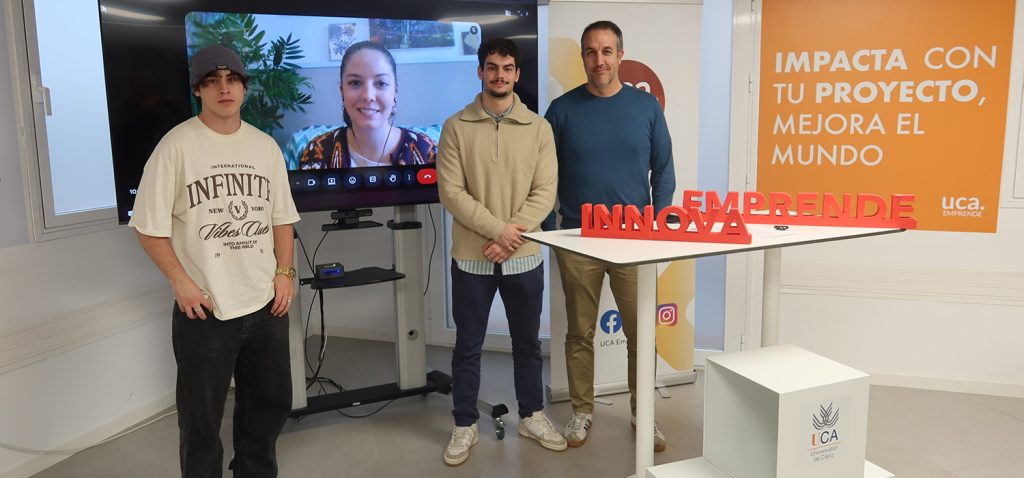
The University of Cádiz, through UCAEmprende, showcases projects led by students and alumni focused on food sustainability, experiential education and automation through Artificial Intelligence
The University of Cádiz strengthens its commitment to university entrepreneurship and innovation with the presentation of three business initiatives promoted by students and alumni of the institution within the framework of the Talento UCA programme. These projects are technology-based, socially driven and show strong growth potential, reflecting the role of the university as a driver of economic development and social transformation.
Food sustainability, experiential education and automation through Artificial Intelligence were the main themes of an event held at the Imagina Hall of the El Olivillo Building, within the UCAEmprende ecosystem, promoted by the Vice-Rectorate for Entrepreneurship and Employability. The event provided project promoters with the opportunity to share initiatives that demonstrate the talent and innovative capacity of UCA students and alumni with society.
The event included an institutional welcome by Carmen Camelo, Vice-Rector for Entrepreneurship and Employability at the University of Cádiz, and the participation of José Manuel Sánchez, Director General for Entrepreneurship at UCA. Both highlighted the importance of connecting the university environment with society and reaffirmed the institution’s commitment to knowledge transfer.
Presented initiatives
Max Automatizaciones IA is a consultancy specialising in the automation of business processes through Artificial Intelligence. The project is led by Julio Luque, a student of Aerospace Engineering, and Alberto González, a graduate in Business Administration and Management.
Born from the synergy between two very different profiles in terms of academic background and age, the project focuses on identifying repetitive tasks that slow down business growth —such as data management or customer service— and solving them through automated workflows, either via standardised solutions or tailor-made developments. Its value proposition is clear: to free up time and resources so that people can focus on delivering real value, enabling companies to scale without increasing their organisational structure or changing their usual tools.
The second initiative is EducAven, a digital search platform for experiential educational and leisure activities aimed at children aged 0 to 12. The platform connects families and educational institutions with companies in the sector in Cádiz and its surrounding area. The project is mainly driven by Rocío Montoya, a graduate in Early Childhood Education with specialised training in business creation and innovative project development.
EducAven brings together extracurricular activities, school trips, workshops, events, camps and celebrations in a single space, making decision-making easier through personalised filters, detailed information and a simple booking process. The project responds to a real need: saving time for families and teachers while providing visibility and growth opportunities for local educational businesses, promoting active and meaningful learning.
The third initiative, which has already become a reality, is PlatPal, a digital platform aimed at reducing food waste in university cafeterias and dining halls. The project is led by Juan Carlos Pazo, a student of the Double Degree in Law and Business Administration and Management.
PlatPal allows users to reserve surplus menus once the daily service has ended and facilitates direct collection at the venue. The model benefits cafeterias by reducing losses and improving sustainability, while students, university staff and the general public gain access to complete meals at reduced prices. PlatPal is based on a simple, transparent and scalable system, with a view to future implementation in other educational environments.
The University of Cádiz has consolidated its position as a key player in the creation of innovative companies in the province through UCAEmprende, a programme that offers a comprehensive support ecosystem for university entrepreneurship. Specialised training, mentoring, workspaces and a strong network of contacts make up a model designed to transform academic talent into competitive and sustainable business ventures.
The initiatives presented within Talento UCA are tangible results of this institutional strategy and reflect the University of Cádiz’s commitment to the socio-economic development of its environment, through innovation, applied knowledge and the promotion of an entrepreneurial spirit within its university community.