

SEA-EU Alliance opens a new chapter in Naples under UCA leadership 28 November 2025
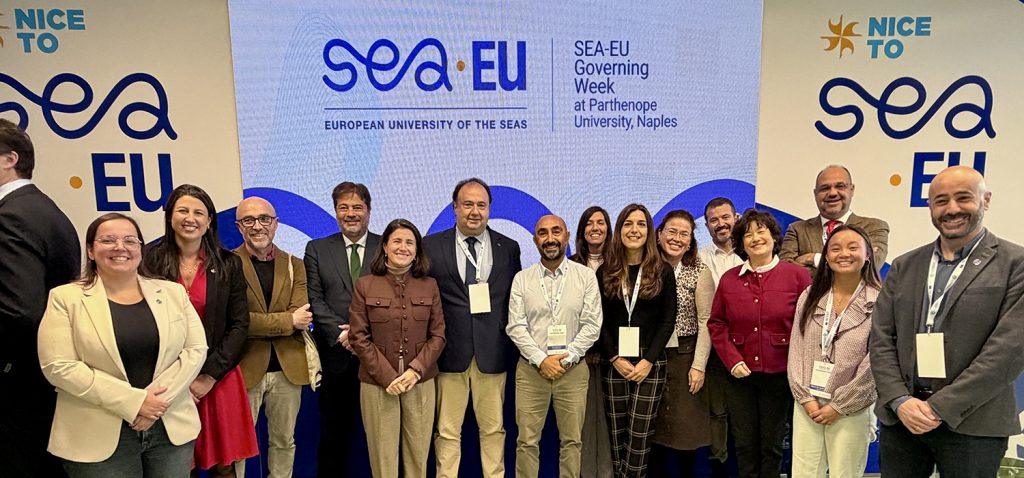
Following the signing of the new SEA-EU Association, the legal entity will secure the long-term continuity and stability of the Alliance
The university of Cádiz has played a leading role in the Governance Week of the European Alliance, SEA-EU, held in recent days at the Naples university, confirming its position as coordinating institution and strengthening its leadership at a decisive moment in the project’s future.
The event brought together representatives from the nine partner universities in a comprehensive programme of strategic meetings, multilateral discussions and institutional sessions, culminating in a historic milestone: the signing of the new SEA-EU Association, the legal entity that will ensure the Alliance’s long-term continuity and stability.
UCA travelled to Naples with one of the largest delegations attending the summit, led by its rector, Casimiro Mantell, and formed by vice-rectors, academic directors and the technical staff of the SEA-EU Office. The Cádiz representation maintained a prominent and sustained presence across all major decision-making bodies throughout the week, including the Council of Rectors, the Governing Board, and the committees responsible for quality, ethics, technical coordination, student engagement, faculties, port and city relations, and territorial governance. This transversal participation once again reaffirmed the firm institutional commitment of UCA to the governance and strategic direction of the Alliance.
The most significant moment of the week took place during the Governing Board plenary session, when the Alliance rectors formally signed the Statutes of the new SEA-EU Association. This signature marks a decisive step towards a stable governance model, designed to extend beyond European funding cycles and strengthen the Alliance’s international projection. The General Coordinator of SEA-EU, Marcela Iglesias, stated that this new legal framework “reflects the maturity achieved by the Alliance and paves the way for a phase of sustained growth and development.”
Throughout the Governance Week, the Alliance governing bodies advanced in key areas that will shape the future of the European University initiative. Discussions focused on progress in joint academic programmes, mobility standardisation, scientific cooperation, campus wellbeing, faculty involvement and strategic priorities for the next phase of SEA-EU. The executive committee devoted a substantial part of its agenda to preparing the proposal for a two-year extension requested by the European Commission, while the city and port councils reinforced the Alliance’s connection to its urban, territorial and maritime ecosystems. In this context, UCA formally reiterated its institutional support for Jerez’s candidacy as European City of Culture, underlining the importance of embedding the city’s cultural and creative networks in the European and international outreach strategy being promoted by UCA.
The Governance Week concluded with a shared sense of progress and strategic alignment. With a consolidated legal structure and a jointly agreed roadmap, the SEA-EU Alliance is ready to address new challenges in joint education, research, mobility and territorial cooperation. The next institutional gathering will take place in Brest, in June 2026, where UCA will continue to hold a central role in the evolution of the project it has coordinated since 2019, and has led strategically since 2019.
The SEA-EU Alliance, created to promote a shared model of the European University that connects cities and ports, begins this new chapter from Naples with reinforced institutional backing, a long-term vision and a stable governance structure.
Alianza Europea SEA-EU was hosted by Università degli Studi di Napoli Parthenope, with leadership coordination led by Universidad de Cádiz.