

Rector of the University of Cádiz Accompanies the President of the Andalusian Regional Government on a Visit to the Valcárcel Restoration Works 19 January 2026
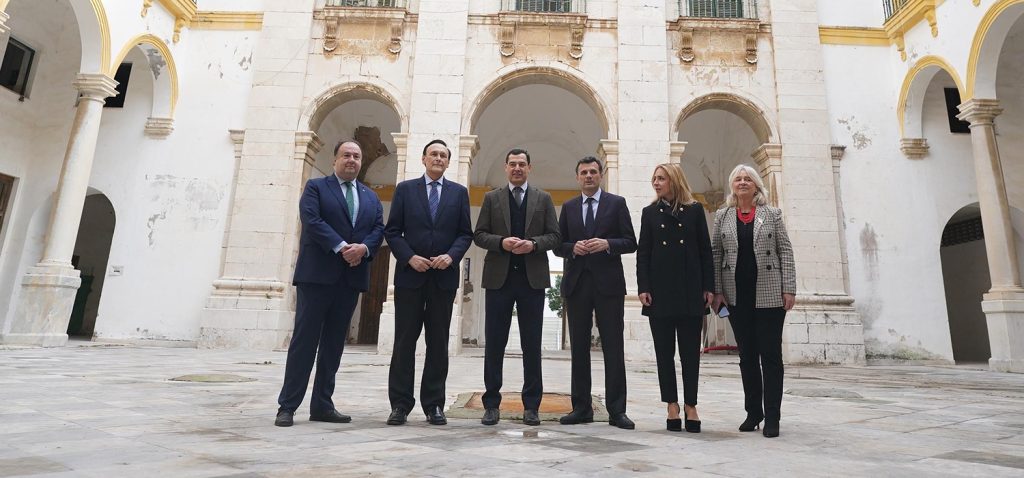
The current works, which began in October, will reinforce the foundations and structure, repair roofs and façades, and address water infiltration issues
The Rector of the University of Cádiz, Casimiro Mantell, accompanied the President of the Andalusian Regional Government (Junta de Andalucía), Juan Manuel Moreno, on Thursday morning during a visit to the ongoing works at the Valcárcel building, located in the vicinity of the Cádiz Campus. The visit was also attended by the Regional Minister for Universities, Research and Innovation, José Carlos Gómez; the Andalusian Government’s delegate in Cádiz, Mercedes Colombo; the President of the Provincial Council of Cádiz, Almudena Martínez; and the Mayor of Cádiz, Bruno García.
The visit provided an opportunity to review the progress of the works, which began last October. During the tour, the President of the Andalusian Regional Government stressed that the building “will be restored” and that the public will be able to enjoy its future uses, including those linked to the University.
The current works form part of the building consolidation project, which includes a series of urgent and essential interventions to ensure the preservation of the property. Key actions include the reinforcement of the foundations and structural elements, the repair of roofs and façades to guarantee weatherproofing, as well as various safety and protection measures. Among the works already completed is the demolition of adjoining buildings that did not have heritage protection status.
The works in the surrounding area are particularly delicate, as the building is listed as a Site of Cultural Interest (BIC) as a Monument and is also classified as a Historic Site linked to the locations of the Cortes and the Constitution of 1812.
The Valcárcel building is a unique example of late Cádiz Baroque architecture with Neoclassical elements that lend it a sense of rationality and modernity for its time. It was built between 1730 and 1763 and is currently in a very poor state of conservation as a result of more than two decades of disuse and lack of maintenance, compounded by its direct exposure to the marine environment.