

Moeve Foundation Chair Recognises Two ETSIA Projects for Their Contribution to the Energy Transition 19 January 2026
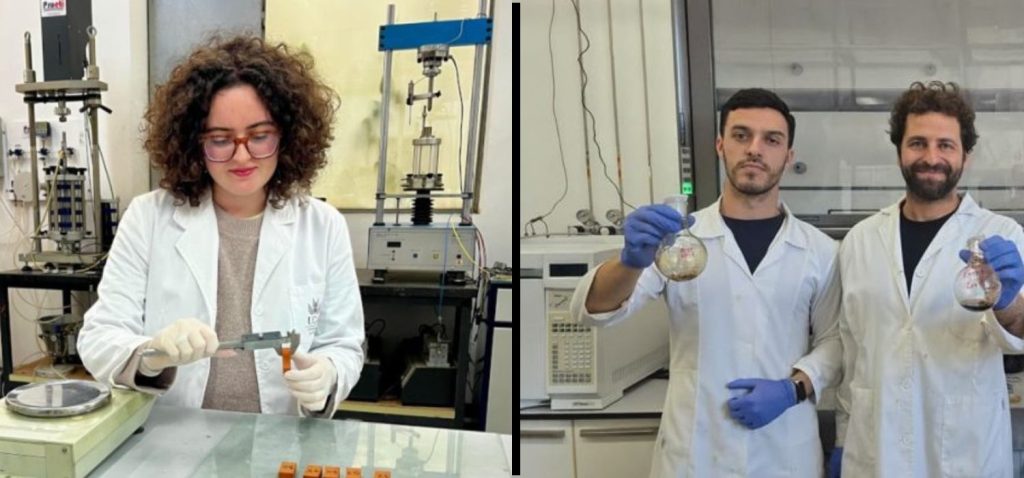
Graduates Patricia García-Herrera and José Ángel Cano were honoured for the innovative nature of their research, focused on sustainable development
The latest call for awards from the Moeve Foundation Chair has recognised two graduates from the Higher Technical School of Engineering of Algeciras (ETSIA) in the energy transition category. These awards highlight the academic excellence of final degree projects that contribute to promoting industrial innovation and sustainable development, in line with today’s energy and environmental challenges.
One of the award-winning projects was carried out by Patricia García-Herrera Cruces and is entitled Evaluation of the Mechanical and Physical Properties of New Sustainable Ceramic Materials for Construction. The project was supervised by Juan María Terrones Saeta and Pedro L. Guerrero Santos. The research proposes an innovative solution for transforming environmental liabilities into useful resources through the manufacture of ceramic bricks using industrial waste such as aggregate washing sludge and phosphogypsum.
The project was developed in the context of the province of Huelva, an area particularly affected by the accumulation of waste derived from the chemical industry. The study’s main technical contribution lies in the partial replacement of traditional clay with mixtures incorporating between 5% and 20% phosphogypsum as an alternative raw material. The results show that incorporating up to 15% phosphogypsum makes it possible to maintain mechanical properties suitable for construction use, while complying with the leaching limits established by the Environmental Protection Agency (EPA). In this way, the proposal ensures the immobilisation of potentially toxic elements and contributes to reducing the carbon footprint of the ceramic sector.
The second recognised project corresponds to José Ángel Cano Sody for his study entitled Crude Production from the Reuse of Aeronautical Resins through Hydrothermal Liquefaction and Liquid–Liquid Extraction, and State of the Art of Its Upgrading by Catalytic Hydrogenation, supervised by José María Abelleira Pereira. This research focuses on the valorisation of the liquid effluent generated during the recycling of carbon fibre-reinforced composite materials from the aeronautical sector.
The study demonstrates that the aqueous phase, traditionally regarded as waste with no recovery potential, can be transformed into a feedstock with significant energy potential. Through hydrothermal liquefaction processes and subsequent upgrading treatments, it is possible to increase the energy value of the final product, steering it towards use as an advanced fuel. This line of research opens up new opportunities to improve the sustainability of sectors with high energy demands, such as aviation and heavy transport.
Both projects stand out for their clear alignment with the Sustainable Development Goals and the principles of the circular economy, as they propose technological solutions that promote more efficient resource use and waste reduction. The applicability and relevance of this research reinforce the role of applied engineering as a driver of industrial and social transformation, particularly at the regional level.