

International Study with Participation from the University of Cádiz Produces the First Global Map of Heat Flow on Venus 27 February 2026
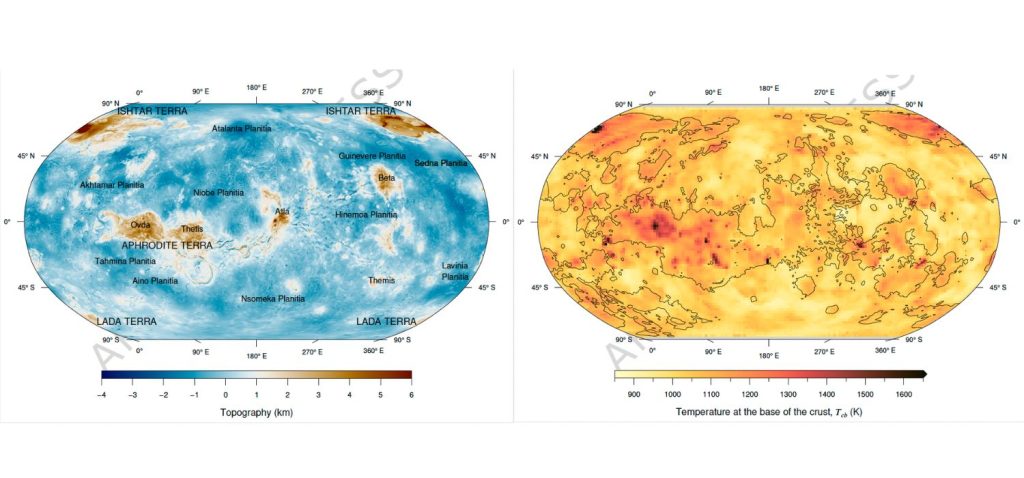
The research, published in Communications Earth & Environment, provides the first estimate of the planet’s total heat loss and highlights key differences in the internal evolution of Venus and Earth.
An international study involving the University of Cádiz has produced the first global map of heat flow on Venus, a major advance that allows scientists to estimate the planet’s total heat loss for the first time and gain new insights into its internal dynamics. The research shows that Venus dissipates proportionally much less heat than Earth, pointing to a markedly different thermal evolution between the two planets.
The study was conducted by researchers from the Complutense University of Madrid, King Juan Carlos University, the University of Cádiz, the Technical University of Denmark and the University of Ottawa. Representing the University of Cádiz was Isabel Egea-González, a researcher from the Department of Applied Physics at the School of Engineering of the University of Cádiz.
Although Earth and Venus are often referred to as “twin planets” due to their similar size and mass, the results reinforce the idea that their internal processes have followed very different evolutionary paths. While Earth’s internal dynamics are dominated by plate tectonics and highly efficient heat loss, the study concludes that heat flow on Venus is lower and more evenly distributed geographically.
The research also estimates that Venus’s total heat loss is comparable to the heat generated by the radioactive decay of elements within its interior, suggesting that the planet is cooling very slowly. In addition, the study identifies areas with elevated heat-flow values linked to rift systems, regions where the lithosphere deforms and separates.
These localised zones contrast with a globally less structured pattern than that observed on Earth, a difference interpreted in the context of the absence of active plate tectonics on Venus.
The participation of the University of Cádiz in this research contributes to advancing knowledge about the geological evolution of Venus and, more broadly, about the internal processes that shape the thermal history of rocky planets.
The scientific article, titled “Heat loss and internal dynamics of Venus from lithosphere strength,” is authored by Javier Ruiz, Alberto Jiménez-Díaz, Isabel Egea-González, Ignacio Romeo, Jon F. Kirby and Pascal Audet, and was accepted for publication in Communications Earth & Environment in 2026.
Bibliographic reference:
Ruiz, J., Jiménez-Díaz, A., Egea-González, I. et al. Heat loss and internal dynamics of Venus from lithosphere strength. Communications Earth & Environment (2026). https://doi.org/10.1038/s43247-026-03278-5