

International Experts Gather at UCA for the 11th International Congress of Hispanic Lexicography 9 June 2026
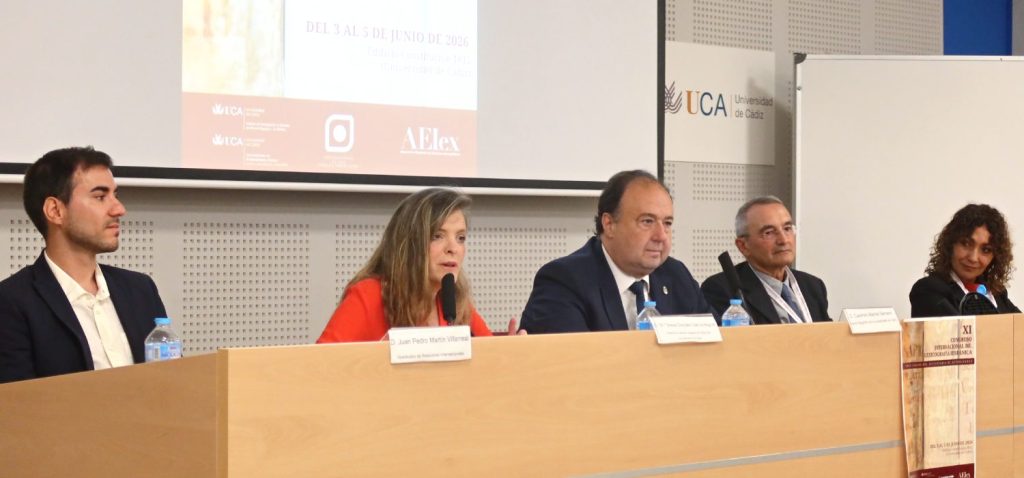
The event commemorates the tricentenary of the Diccionario de Autoridades and brings together researchers to discuss the evolution and current challenges of Hispanic lexicography.
The University of Cádiz is hosting the 11th International Congress of Hispanic Lexicography from Wednesday to Friday, bringing together specialists from several countries to examine the development of lexicographical studies and commemorate the 300th anniversary of the publication of the Diccionario de Autoridades, the first academic dictionary of the Spanish language.
Held at the Constitución 1812 Building, the congress is organised by the University’s Department of Philology and the Institute for Research in Hispanic World Studies (IN-EMHis), in collaboration with the Spanish Association of Lexicography (AELex).
The opening ceremony was attended by the Rector of the University of Cádiz, Casimiro Mantell; Cádiz City Council’s Deputy Mayor and Councillor for Culture, Maite González; the Vice-Dean for International Relations of the Faculty of Arts and Humanities, Juan Pedro Martín; the President of the Spanish Association of Lexicography, Cecilio Garriga; and Professor Teresa Bastardín, chair of the organising committee.
The event began with a minute of silence in memory of José Manuel Blecua, distinguished philologist and former Director of the Royal Spanish Academy. During his remarks, Cecilio Garriga paid tribute to Blecua’s academic legacy and personal qualities. “Always kind and approachable, he left an indelible mark on those of us who had the opportunity to know him. José Manuel was not only a central figure in Spanish lexicography, but also a deeply respected and admired person,” he said.
In his address, Rector Casimiro Mantell thanked the organisers for choosing both the University of Cádiz and the city as hosts of the congress. He also reflected on some of the current challenges facing higher education, highlighting the importance of advancing the internationalisation of teaching and learning. Mantell stressed that the Spanish language represents one of the greatest strengths of Spanish universities in their international projection.
“There are many people around the world who wish to learn and study in our language, and we must continue to develop ways of internationalising our teaching through that opportunity,” he stated.
Maite González emphasised Cádiz’s long-standing relationship with language and the cultural history of the Hispanic world. She recalled that the city was selected to host the Ninth International Congress of the Spanish Language and highlighted the “linguistic richness of a city shaped by centuries of cultural exchange.” According to González, Phoenician, Roman, Arab, French, Genoese and American influences have all left a profound imprint on the vocabulary of Cádiz, making the city a particularly meaningful setting for a congress dedicated to the study of words and dictionaries.
Professor Teresa Bastardín highlighted the history of the congress, which was established by the Spanish Association of Lexicography and has become a leading forum for research on the Spanish lexicon. She noted that the eleventh edition holds special significance as it coincides with the commemoration of the tricentenary of the Diccionario de Autoridades, a landmark work in the history of academic lexicography.
Juan Pedro Martín welcomed participants and expressed his satisfaction with the strong international representation at the event. He underlined the value of a congress devoted to the study of the Spanish language and reaffirmed the global importance of Spanish as a vehicle for knowledge, research and academic exchange.
In the same vein, Cecilio Garriga thanked the University of Cádiz for hosting the congress and recalled that Cádiz’s candidacy had received unanimous support from the Spanish Association of Lexicography. In his view, the city’s rich historical heritage and the University’s long-standing tradition in Hispanic Philology make Cádiz an ideal venue for a scientific meeting dedicated to the history and evolution of Spanish dictionaries.
Over the course of three days, the congress will serve as a forum for specialists in theoretical and practical lexicography, dictionary history, dialectal lexicography, historical lexicography and specialised lexicography, as well as for the presentation of new research projects. The programme includes three plenary lectures, a round-table discussion on current advances and future challenges in Spanish lexicography, and numerous scientific presentations.
Alongside the academic sessions, participants will be able to enjoy a range of cultural activities, including exhibitions on the history of academic lexicography and a guided tour of Cádiz. These initiatives further strengthen the connection between linguistic research and the city’s rich cultural heritage.