

International Development Cooperation, when the UCA’s purpose “is to make the world a better place” 19 December 2025
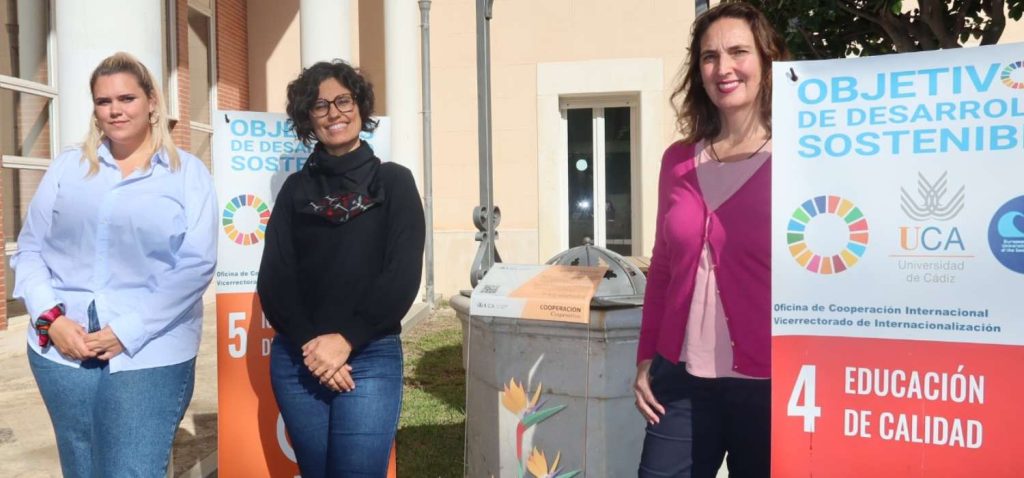
Lucía Molina, Inmaculada Antolínez and Esther Puertas explain how the Office for International Development Cooperation of the University of Cádiz operates and outline the objectives it pursues in its work.
The University is teaching, it is research and, increasingly, it is knowledge transfer. A form of transfer understood not only as the application of knowledge to the productive sector, but also as the promotion of initiatives that contribute to the well-being and progress of the society in which it is embedded—and also of those that look beyond the immediate environment. The very word university points to this broad and open vocation. From its etymological roots, it shares an origin with the concept of the universal: that which forms part of a whole, what unites us beyond geographical or cultural borders. In this sense, what happens anywhere in the world is not alien to the University of Cádiz. Global challenges directly engage the university institution and form part of its natural field of action.
From this perspective, international cooperation becomes an essential component of the University’s social commitment and its mission of knowledge transfer. To cooperate is to share knowledge, capacities and experiences, but also to assume responsibilities and contribute—within the academic sphere—to fairer and more sustainable development. At the University of Cádiz, this work is channelled through the Secretariat for International Development Cooperation, under the Vice-Rectorate for Internationalisation. From this platform, projects, training programmes and actions are promoted that strengthen the role of the UCA as an active agent in sustainable human development, in collaboration with institutions, organisations and communities in different countries. Along these lines, Inmaculada Antolínez, Director of the Secretariat, together with Esther Puertas, technician at the Office for International Development Cooperation, and Lucía Molina, international student volunteer, reflect on the mission and commitment of the University of Cádiz to development cooperation.
Why is it important for international cooperation to be part of the University’s structure and not something peripheral?
Inmaculada Antolínez (I.A.)
Because the university is, by definition, a recognised actor in cooperation. Not only from a regulatory standpoint—the university legislation and the LOSU clearly establish universities’ responsibility in relation to the Sustainable Development Goals (SDGs)—but also from an ethical dimension. The university generates knowledge, and that knowledge must help to improve society. It is not only about teaching and research, but also about social impact. Beyond regulations, we believe there is a clear ethical obligation. The university cannot limit itself to producing abstract knowledge; it must ask what that knowledge is for and whom it benefits. In that sense, university cooperation allows knowledge to be oriented towards reducing inequalities and social transformation. For me, the ultimate purpose is simple—although it may sound naïve: to help make the world a slightly better place.
Esther Puertas (E.P.)
In addition, cooperation is directly connected to education. It is sometimes presented as something secondary or as a trend, but in reality it is fully aligned with the university mission. Universities educate future generations, and that education is not only technical, but also ethical. Cooperation makes it possible to work on values such as social justice, human rights and sustainability through real-life experiences and applied research for development.
What role does the University play as a training space in this area?
E.P.
The university is a privileged space for educating critical citizens. This is not about philanthropy or paternalism, but about responsibility. University cooperation provides a global perspective and helps to understand that local problems are connected to global dynamics. Moreover, we have resources, knowledge and analytical capacity that other actors do not always have, which allows us to add real value to cooperation projects.
What is the mission of the Secretariat for International Development Cooperation of the University of Cádiz?
I.A.
The Secretariat structures the role of the University of Cádiz as a cooperation actor. We work along several complementary lines. On the one hand, training in development education and international cooperation, aimed at the entire university community—students, PDI and PTGAS—and tailored to each group. On the other, university development cooperation missions, which help to identify needs on the ground and formulate projects aligned with the SDGs, a human rights approach and environmental sustainability. Finally, the international volunteering programme, which seeks to accompany students in transformative learning experiences, always from a critical and responsible perspective.
What role does international volunteering play within this strategy?
E.P.
Volunteering is a key component, but always from a very careful approach. It is not simply about “going to help”. We are committed to a well-trained, well-supported form of university volunteering, linked as far as possible to each person’s field of knowledge. The university acts as a mediator and facilitator, building stable relationships with partner organisations and ensuring a high-quality learning experience.
I.A.
We also believe that university volunteering has a very clear added value. Students do not go as graduated professionals, but as people in training, with knowledge and competences they can contribute. Added to this is a very important ethical training and a critical capacity that is worked on before, during and after the experience.
What are the main volunteering programmes currently offered by the University of Cádiz?
E.P.
We currently run two main programmes. On the one hand, the General International Volunteering Programme University of Cádiz–Santander Grant, launched in 2021. Training takes place from January to March, with the call published in April. We currently work with Paz y Bien Association in Guatemala, the Serra Schönthal Foundation in Colombia and the Philippines, and COOPERAND amb Llatinoamérica in Bolivia. On the other hand, there is the programme funded by the Provincial Council of Cádiz, which provides continuity and allows us to incorporate initiatives such as the role of University ambassadors. This year, within this programme, we have worked with partners in countries such as Bolivia, Kenya and Mozambique. We prioritise quality over quantity: fewer, well-established destinations with good conditions and proven results, rather than many places without adequate support.
How are students prepared before travelling?
E.P.
Training is mandatory and specific to each destination and partner organisation. It includes knowledge of the context, the project and the organisation they will work with. In some programmes, we have also added additional training focused on the emotional and critical dimension of the experience, with sessions before and after the trip. This has been key in ensuring the experience is truly transformative.
Lucía, in your case, how did the process of taking part in the volunteering programme unfold?
Lucía Molina (L.M.)
I learned about the programme through lecturers on my degree, Social Work, who had participated in projects in Guatemala. We became interested, completed the training and applied when the call was published. I was selected through the Santander programme. It is very important that this information reaches the classroom, through teaching staff. Students often do not learn about these opportunities unless they are explained directly. In my case, that personal contact was essential.
What was the experience like on the ground, both personally and professionally?
L.M.
It was a deeply transformative experience. Professionally, I worked every day on social work tasks: direct support, report writing, community workshops. It gave me enormous confidence and practical training where I could apply all my theoretical knowledge. On a personal level, it changes your perspective. Seeing inequalities first-hand, living alongside such different realities and reflecting on them from within marks you forever. We receive a great deal—perhaps even more than we give—especially in terms of learning and social awareness.
What does the University of Cádiz contribute as an institution to these projects?
I.A.
It contributes trust, stability and networks. The university is a recognised institution, which facilitates long-term relationships with funders and partners. It also makes it possible to integrate research, teaching and cooperation.
E.P.
And it contributes human capital: people with diverse training, critical capacity and commitment. We believe roles should be flexible: the university can accompany projects on the ground, and NGOs can conduct research. Cooperation must be genuinely multi-actor.
Is there a return from these experiences to the University itself?
E.P.
Yes, and increasingly so. Some students go on to orient their final degree projects, master’s theses or even doctoral dissertations towards cooperation. We offer mobility grants, awards for work linked to cooperation and research missions for development. The idea is to create a virtuous circle between experience, research and transfer.
I.A.
We believe that what is not articulated does not exist. That is why it is important to make these pathways visible and recognise them academically. Cooperation is also a way of conducting research for social transformation.
Looking ahead, where should university cooperation be heading?
I.A.
The ideal scenario would be for cooperation to no longer be necessary because structural inequalities had disappeared. Until then, we must move towards more horizontal relationships, based on real exchange, moving beyond the logic of donor and recipient countries. University cooperation must be critical, reflective and transformative, both for those who take part and for the institution itself.