

Hugo Juan Hernández, the Aerospace Engineering student at the University of Cádiz who challenged the skies by diving into the sea 13 February 2026
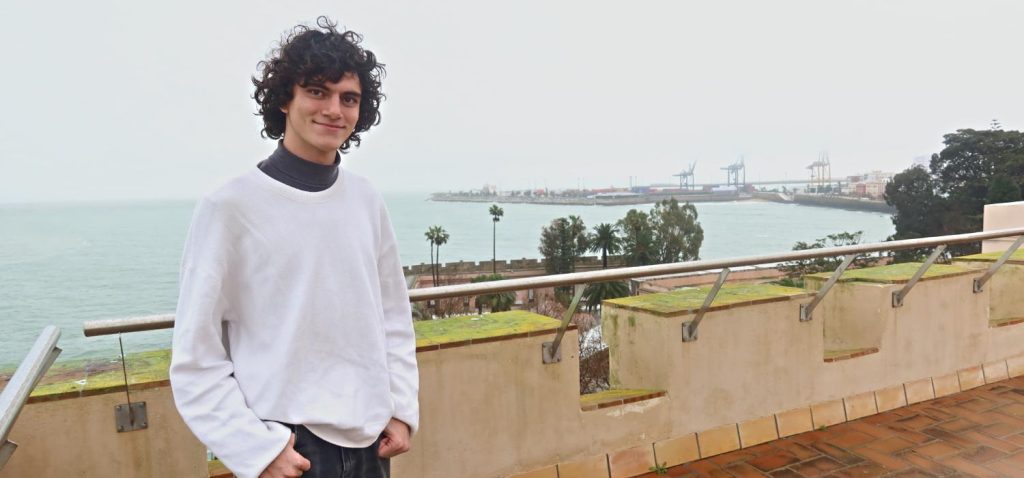
The student was awarded second prize in the ‘Desafío Optidrone’ competition with an aircraft project capable of flying and operating underwater
One of the greatest strengths of knowledge is its ability to dismantle clichés and reveal the many nuances behind reality. Universities consistently challenge simplistic stereotypes with the persistent truth that facts are far more complex and diverse. Hugo Juan Hernández is a clear example of this. If we introduce him as a 21-year-old Aerospace Engineering student at the Higher School of Engineering (ESI) of the University of Cádiz who won an award in a national drone competition, one might picture a mathematics prodigy immersed in textbooks, admitted with the highest possible entry grade. Yet Hugo’s story is far more compelling: his highest mark in the university entrance examinations was in History, while his lowest was in Mathematics; he accessed the degree through the high-performance athlete quota and understands that becoming an outstanding engineer sometimes requires sacrificing an exam. This break from convention led him, in the Desafío Optidrone competition, to design a vehicle capable not only of crossing the sky, but also of navigating beneath the sea.
You are from Santander. Why did you decide to study at the University of Cádiz, nearly a thousand kilometres away?
I looked at several universities offering Aerospace Engineering, including Galicia, Madrid, Barcelona, Valencia, León, Toledo and Seville. In some cases, the city didn’t quite convince me; in others, they didn’t feel like true university environments. Cádiz caught my attention because of its setting and the atmosphere it conveyed. In the end, it’s a city by the sea, and that matters. It is a long distance from home, but the experience is almost like going on Erasmus: you are away most of the year and return at Christmas, Easter or in the summer, when I always go back to be with my parents and work.
Do you work in Santander?
Yes. For the past five years I have worked during the summer for the Spanish Sailing Federation. Sailing has been part of my life since I was very young; I competed at high-performance level and completed vocational training as a Sports Technician. I did not enter the degree programme through my academic grade, since I obtained just over a 10 and the entry requirement was above 12; instead, I accessed it through the high-performance athlete quota. Combining competition and academic studies is challenging, and this system allows those of us who dedicate many hours to sport to continue our education.
I have put sailing somewhat on hold because it is demanding, and now I practise it occasionally when a friend asks me for guidance.
It may seem surprising that, with such a strong passion for sailing, you chose to study Aerospace Engineering.
I think the connection with engineering is quite direct. Sailing is pure aerodynamics, fluid mechanics, structures… It is fascinating how something you practise almost intuitively later becomes understandable through equations. Many people do not stop to consider how a boat can move even against the wind, yet behind it lies highly complex physics — just like the forces that allow an aircraft to take off. If you think about it, an airplane’s wings are like a sail positioned horizontally. I suppose that curiosity to understand what I was already experiencing on the water led me toward engineering.
When did you decide to study Aerospace Engineering?
In upper secondary school I felt quite lost and unsure about which path to follow. I remember the exact moment: a teacher mentioned the degree in class, and it just clicked. I liked how it sounded, but beyond that I started to reflect on what it involved — aerodynamics, structures, physics. These were areas that already interested me. Once you begin, you realise the degree has substantial technical depth and that the leap is significant. The pace and level of demand are completely different from secondary school. The first year is about adapting. But if you truly enjoy it, you continue.
You mentioned the difficulty of certain subjects, which can discourage prospective students. What would you say to those who avoid engineering because of that?
I would tell them not to base their decision solely on a subject that seems intimidating. Sometimes we confuse “I am good at this subject” with “I like this career or profession”, and they are not the same. I chose the degree because I enjoyed physics. Mathematics has never been my favourite subject, but you learn to understand it and move forward. Ultimately, what you study at university represents only a small part of what your professional life will involve. As an engineer, you will not be solving calculations by hand every day. What truly matters is genuine interest in the field and curiosity. The rest can be learned through effort. In my case, my highest mark in the university entrance examinations was in History, and my lowest was precisely in Mathematics.
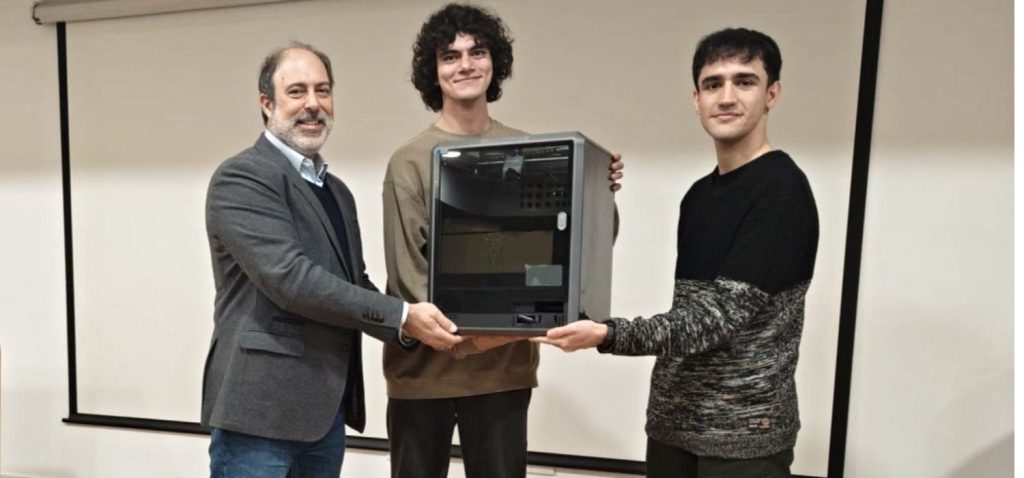
Hugo Hernández recoge el premio del Desafío Optidrone en la Escuela Superior de Ingeniería.
You mentioned that you set sailing somewhat aside when you started your degree. I assume that was to focus fully on your studies.
Not exactly, because I am always experimenting with different projects and looking for new challenges. In my second year at the School, I joined UCA&Air, the University of Cádiz’s aeromodelling team. At first, I was responsible for aerodynamics, and later I became Head of Design. We achieved good results, finishing third in a national competition. In my third year, I also took part in an Airbus rocket design contest, and I am currently a member of the Formula Gades team.
At the student associations fair held by the University of Cádiz a few months ago, the Rector stressed the importance of taking part in associations to complement academic life. What is your view?
That additional training is essential. In these projects, you apply what you learn in class, but above all you learn how to work in a team and take on real responsibilities. If your part does not move forward, it does not affect only you — there may be 60 or 70 people behind it. That completely changes your perspective. It is also an environment where you can make mistakes, learn and improve without facing serious professional consequences. It is very realistic preparation for what comes next. The only thing you cannot afford is disappointing your teammates by not putting in the effort or not taking your role seriously. I have even sacrificed exams because we were working against tight deadlines on component design. I once had the curious experience of reviewing an exam with a professor while, at the same time, we were manufacturing complex precision components for one of his teams.
As I said, it is also a way of building community. I would regret finishing my degree without having taken part in something like this, because it is where you truly begin to understand how the professional world operates.
We have not yet spoken about Desafío Optidrone, the national drone competition in which you won second prize. What was the process like?
I learned about the competition through an email sent to students and decided to apply. The guidelines did not clearly specify what type of vehicle had to be designed, so I chose to propose something different. I knew that many entries would follow the conventional path — the typical photography or delivery drone. So I thought: if I can innovate, I will. I designed a hybrid drone capable of operating both in the air and underwater, with a coaxial motor configuration, intended for inspection tasks in maritime environments such as offshore infrastructures. The aim was to reduce human risk and optimise resources in this type of operation. It was an interesting challenge, as it required not only structural optimisation — which was the basis of the competition — but also consideration of real-world applications, operational environments and overall feasibility. Beyond the award itself, what I value most is the process: researching, designing, refining and defending the project.
What are your plans now?
At the moment, I am focused on Formula Gades, where we aim to improve on last year’s results. It will not be easy — the team achieved a first, third and fifth place finish. And of course, my goal is to complete my degree as successfully as possible. Afterwards, I would like to pursue a master’s degree; there are several options that interest me, but I want to consider them carefully. I am also attracted by the idea of working abroad for a period of time. I do not have a fixed plan, but I do have a clear intention: to keep learning, to remain involved in projects, and not to limit the university experience to strictly academic matters.