

25 Years of Ramón y Cajal at the University of Cádiz: A Passport to Stability and Excellence 31 October 2025
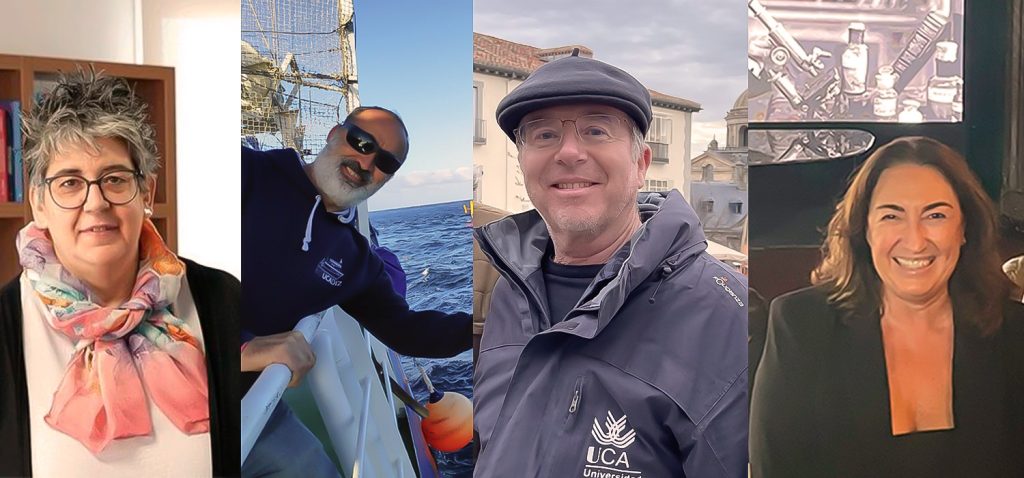
Researchers from the University of Cádiz Carmen Castro, Alfredo Izquierdo, Fernando Ojeda, and Susana Trasobares reflect on how participating in the Ramón y Cajal program shaped their careers.
A quarter of a century can bring about significant changes. In 25 years, Spain has had three different Prime Ministers, and the Catholic Church has seen three different Popes. In this time, the University of Cádiz has had five rectors and welcomed 47 researchers under the Ramón y Cajal program—a national initiative launched in 2000 to foster the return and consolidation of scientific talent within the Spanish university system.
The program has not only offered stability during the often uncertain early stages of research careers, but it has also helped strengthen cutting-edge research in both basic and applied sciences at the university. Among the first beneficiaries of the program at the University of Cádiz, back in 2001, were Alfredo Izquierdo González (Department of Applied Physics) and Fernando Ojeda Copete (Department of Biology), pioneers who paved the way for future “Ramones y Cajales” in the institution. In 2003, the first female researchers joined: Susana Trasobares (Department of Materials Science and Metallurgical Engineering and Inorganic Chemistry) and Carmen Castro (Department of Biomedicine, Biotechnology, and Public Health).
In this four-way interview, these researchers discuss what the Ramón y Cajal program meant to their careers and reflect on the challenges faced by early-career researchers, both then and now.
What did obtaining the Ramón y Cajal contract represent for your career?
Carmen Castro (C.C.):
It was a turning point in my scientific career. It gave me the opportunity to return to Spain and build an independent research group at the University of Cádiz. This contract allowed me to transform the experience I gained during my postdoctoral stage into a personal line of research, with defined goals and international projection. Personally, it allowed me to grow and mature both in research and teaching, and it gave me the freedom to develop innovative projects that have consolidated my group and generated scientific impact. I was able to apply for competitive funding, attract young researchers, and establish national and international collaborations that enhanced the visibility and relevance of our work. It also marked my full integration into university life, combining teaching in the Medicine and Physiotherapy degrees with research. Since then, I’ve felt enthusiastic about contributing to UCA’s scientific and educational growth — to generating knowledge, which I believe is what truly defines a great university, and to training future generations of doctors, physiotherapists, and researchers.
Alfredo Izquierdo (A.I.):
For me, it was the first stable (five-year), full-time contract I secured in the academic and scientific field. I can’t say it was the key reason I continued my scientific career, but it certainly was what allowed me to remain at the University of Cádiz 25 years later. In hindsight, it’s hard to say whether it was the best option possible. Personally, I feel moderately satisfied with the teaching and research work I’ve done over these years. With my incorporation into the Physical Oceanography: Dynamics group (REN-205), new lines of research in Ocean Numerical Modelling and Operational Oceanography began. Within these, we’ve carried out numerous research projects, master’s theses, and PhD dissertations.
Fernando Ojeda (F.O.):
Above all, it gave me a sense of calm. I completed my PhD without a scholarship at the University of Seville. I even turned down a grant because I didn’t want to change the topic of my thesis. After that, I spent two years doing postdoctoral research in South Africa, then returned to Seville on postdoc contracts similar to the Juan de la Cierva ones. I had two two-year contracts and a third one lasting ten months, all linked to projects led by other researchers. The Ramón y Cajal contract brought peace of mind: I had five years ahead of me to develop my own project. It was also a great joy, and above all, it gave me renewed enthusiasm. I was returning to the University of Cádiz — to Cádiz, where I had already worked on my doctoral thesis, studying the biodiversity of heathlands in the Strait of Gibraltar.
Susana Trasobares (S.T.):
My profile was a bit different from many researchers. I was already working abroad, and my doctoral degree was awarded by Université Paris-Saclay. Obtaining the Ramón y Cajal contract allowed me to return to Spain and develop my research career here. I had been away for five years when the first call came out, but at that time they required the official recognition of the PhD title, so I had to wait two more years before I could apply. The next time, I was able to apply. While the recognition process was ongoing, I continued training in the United States. There, my thesis advisor suggested I get in touch with José Juan Calvino, a microscopy expert in Spain and particularly at the University of Cádiz (with which I had no previous connection). And since then, I’ve been able to continue working in Spain.
Are these contracts a valid incentive to remain in Spain?
Carmen Castro (C.C.):
The Ramón y Cajal contract is undoubtedly a major incentive, not only to return to Spain but also to consolidate an independent scientific career. It’s a highly competitive and prestigious program that offers the opportunity to launch one’s own research line with a certain level of stability and initial resources. In my case, it represented a real opportunity to develop an ambitious project and contribute to strengthening biomedical research at our university. Of course, the impact of this experience depends heavily on the environment you join. When there’s a good connection with the host department and institution, the contract can become a true driver of personal and professional growth. In that sense, I believe programs like Ramón y Cajal are essential for attracting and retaining scientific talent in Spain and should continue to be reinforced to ensure full and lasting integration of researchers.
Alfredo Izquierdo (A.I.):
Undoubtedly, they are an adequate incentive for staying in Spain — or for coming (or returning) here. However, I believe the main uncertainty lies in the long-term research trajectory. What are the current chances of continuing a research career in Spain once the Ramón y Cajal contract ends? This program was originally designed to support the transition toward a knowledge-based economy. However, 25 years later, my impression is that this transition has been marginal and focused mostly on commercial aspects, with little impact on the structure of the national education and research system.
Fernando Ojeda (F.O.):
That was, and still is, the idea: not only to keep talent in Spain but also to bring it back or attract it from abroad. For many foreign researchers, these contracts have made coming to Spain very appealing. I won’t get into academic policy matters, but the truth is that for a long time the Spanish university system has lacked renewal. In many departments — though not all — there has been significant academic inbreeding, with staff hired who weren’t always the most deserving. The Juan de la Cierva and Ramón y Cajal contracts have helped bring in highly qualified profiles. Today, the beneficiaries are arguably even more outstanding than those in the early years. The university benefits from these people, though it still coexists with other dynamics. Add to that the Marie Curie or Emergia programs, which ensure strong scientific training. Slowly, Spanish universities are turning more to those pools of excellence and leaving behind less rigorous models. And I truly believe that talent can be contagious — but the reverse is also true: working alongside mediocre individuals risks holding you back. Ramón y Cajal researchers usually bring drive, curiosity, and leadership. They seek funding, attract doctoral and postdoctoral researchers, and energize the research environment. I’ve witnessed this at the University of Cádiz. I’ve seen how that mindset — and that profile — have gradually transformed our institution and contributed to its growth.
Susana Trasobares (S.T.):
More than an incentive to stay, for me it was what made it possible to return to Spain. Many researchers have had to go abroad over the years, and many of them are still there because they don’t have the chance to continue their work here. Contracts like Ramón y Cajal are crucial, especially when you’re no longer a freshly minted PhD and need some degree of stability — both personally and professionally. These contracts give you the opportunity to establish your own line of work and gain a foothold in your field. In my case, I was awarded the grant in 2003 and joined the University of Cádiz in 2004 after completing the credential recognition process.
You were among the first at UCA to obtain this kind of contract. How has the situation for early-career researchers changed since then?
Carmen Castro (C.C.):
I believe that the situation for early-career researchers has improved in some respects, with greater visibility and institutional support. However, the level of competitiveness has significantly increased, and today the requirements to obtain this type of contract are extremely demanding. Moreover, the path to job security after the contract ends is not the same for all recipients. Much depends on the institution where you’re based.
Alfredo Izquierdo (A.I.):
Part of the answer lies in what I said before. Spain is an attractive country to live in, and our education and science systems produce well-trained young people and capable researchers (in some cases, despite the system…). There are opportunities at regional and national research centers and through competitive programs (such as Juan de la Cierva), but their number is too limited to truly enable the long-promised transition to a knowledge economy. Spain’s investment in R&D&I remains well below the EU and OECD averages even after 25 years — and shows no signs of improving. The role of universities in this context is completely dependent on decisions made by national and regional governments; they lack autonomy.
Fernando Ojeda (F.O.):
Precarity is — and continues to be — a reality in the research world. Research is a vocational profession with a strong creative component. Those who choose this path do so because they are curious and driven — not just to publish for the sake of publishing, but because they want to tell a story, to ask and answer meaningful questions. For that, motivation is essential. Without it, the effort isn’t worthwhile. Once the thesis is completed, the ideal path is to go abroad, to other centers, to learn new things and bring back fresh ideas. But that precarity and lack of long-term security have long been — and often still are — inherent to a research career.
Susana Trasobares (S.T.):
I was part of one of the first cohorts to benefit from this program, and the difference between then and now is huge. Back then, the contract covered the salary and around €6,000 for the full five years — just enough to get set up and start working. Conditions now are much better: the Ministry provides €50,000 for research expenses, plus another €50,000 if the talent-attraction supplement is included. Additionally, the university’s own programs fund a predoctoral contract and offer installation support and departmental funding for hosting researchers. Both at the UCA and national levels, significant progress has been made. The early years were difficult, as everything had to be built from scratch, but today’s awardees enter with a much clearer path toward long-term integration into the university.
Is there any measure you would implement to help consolidate the research careers of young PhD graduates?
Carmen Castro (C.C.):
One of the first measures I would implement would be to encourage mandatory mobility outside the home university for a few years before returning. This allows early-career researchers to be exposed to different research approaches, methodologies, and working environments, while also helping them build international contacts and high-level collaborations. I would also propose expanding access to competitive postdoctoral contracts, to help young researchers build up their scientific output and ease their transition to more stable and leadership-oriented positions. I also think it would be highly beneficial—like in other countries—to create mentorship and personalized guidance programs for researchers at the early stages of their independent careers. These could provide support in career planning, securing funding, and leading research projects, tailored to their specific institutional contexts.
Alfredo Izquierdo (A.I.):
In my view, it’s not just about implementing individual measures but about having a strategy. Many supposedly “innovative” measures are constantly introduced across different areas, just to maintain the status quo — the classic “change everything so nothing changes.” I don’t see any real political will, and in the current situation, I don’t even see sovereign capacity to launch new strategies. Budget increases for research are dictated externally, not internally.
Fernando Ojeda (F.O.):
The key measure would be to increase funding. The real issue is the bottleneck that occurs after the PhD. Many students finish their thesis and face no clear path forward. I, for example, was fortunate to benefit from a foreign scholarship program and spent time in Cape Town with support from the Spanish government. It’s not that you learn more abroad than in Spain, but when you’re in a new environment with different stimuli, your brain stays sharp and you learn more intensely. Again, it all comes down to competition — and that competition will be more productive and healthy the greater the public investment in research. If the system is properly supported, there’s always a place to continue working — whether at universities or public research institutions. I strongly advocate for greater institutional support for research. It’s undoubtedly one of the most valuable resources a country can have.
Susana Trasobares (S.T.):
I believe the biggest problem lies in the transition period between finishing the PhD and securing a Ramón y Cajal contract. We’ve lost that intermediate phase. There used to be postdoctoral grants that allowed researchers to keep working and build experience, but many of those programs have disappeared. The Ramón y Cajal program is highly competitive and geared toward already-established researchers, not recent PhD graduates. What’s missing is foundational support — that crucial bridge between the two stages, which was once covered by postdoctoral calls or programs like Juan de la Cierva Formación/Incorporación. Without it, many young PhDs are forced to go abroad or leave research altogether. So, to answer your question: I would strengthen that transitional stage through targeted funding.
At the beginning of this century, research still held significant social prestige despite not being a lucrative career. Do you think there is now a danger that, alongside ongoing economic challenges, science is also under social attack — especially via social media?
Carmen Castro (C.C.):
While it’s true that research enjoyed considerable social prestige at the start of the century, despite its limited financial rewards, the current situation is different — and perhaps more worrying. We are facing a context where the public perception of science is increasingly challenged, particularly on social media. Moreover, economic pressures disproportionately affect young researchers, who struggle to access stable contracts, rely heavily on temporary projects, and compete intensely for limited funding. This forces many talented individuals to leave science. However, rather than seeing this as a threat, I see it as a call to action. We, as researchers, must communicate the true value of our work, bring science closer to society, and show how it drives progress and well-being. I firmly believe that transparency, active outreach, and participation in science education are powerful tools to improve public trust and respect for research. If we can connect our work to the real needs and hopes of society, we can turn these challenges into an opportunity to strengthen the role and reputation of science.
Alfredo Izquierdo (A.I.):
First, I think the social prestige you’re referring to was very much tied to a bourgeois and classist society. Personally, I see my work as socially necessary — just like that of cleaning staff or administrative workers. But focusing on science and social media, it’s a complex topic. The greatest asset in science is scientists themselves. But they can also be its greatest threat. Our community is plagued by egos, ambition, and a lack of solidarity, and that generates a lot of arguments that can be used against scientists when it’s politically convenient. Without a doubt, social media (and I include traditional media here as early forms of networks) have become very powerful tools of influence — especially because of the growing lack of critical thinking among the population. That’s the result of our educational system. Also, part of my scientific work is in climate and climate change — a topic often weaponized politically, both on and off social media. In my view, the incoherent and sometimes contradictory policies of governments that claim to be committed to climate action give a lot of ammunition to climate deniers.
Fernando Ojeda (F.O.):
I’m not sure there’s a widespread, real perception of this issue, but I do sense a kind of pride in ignorance. In the past, an illiterate person might have felt some shame and tried to hide or correct it. Now, there seems to be a movement of “Yes, I’m ignorant — so what?” Until recently, intellectuals and scientists were at least respected — even if people sometimes looked at them sideways. What’s clear, and what governments are aware of, is that we scientists are still public servants. It’s important for us to be seen as people who can tell stories that resonate with society. Because, ultimately, society is our patron: our work is publicly funded, and we owe it to the public to explain what we do and why it matters. We need to move away from the old image of scientists as alchemists trying to turn lead into gold, and instead show that we’re engaged citizens working to improve the world around us. That gives real social value to our work. Initiatives like European Researchers’ Night or Café conCiencia are great examples of how researchers are becoming more visible — and how people are starting to identify with us and understand the importance of what we do. These activities have also helped raise awareness of the role of women in research, which is another major area where progress is being made.
Susana Trasobares (S.T.):
The problem is that research remains a very unknown world. It’s often associated only with traditional sciences like medicine or chemistry, when in fact there is research in all areas of knowledge. Even within universities, we sometimes don’t know what our colleagues next door are working on. It’s a complex issue: in addition to this lack of visibility, there’s the ongoing struggle to secure funding. Resources for research are limited, and that has consequences. If we want to maintain a high level of excellence, we need consistent investment and time — results don’t appear overnight. Why do I mention all this? Because when funding is interrupted — as we’re currently seeing with certain policies that fail to recognize the value of science — entire research lines can suffer. And it may take years to get back on track. That’s the real danger we’re facing.
Additionally, we asked Carmen Castro and Susana Trasobares if they had experienced additional challenges in their careers due to being women.
Is it still harder for women to build a stable research career?
Carmen Castro (C.C.):
It’s undeniable that there are data showing specific barriers that women face in consolidating a research career — such as implicit bias in evaluations, for example, or the lower participation of women in leadership and high-visibility roles. Perceptions of women’s capabilities are often shaped by outdated education models and, above all, a lack of role models. Female scientific leaders remain underrepresented in the media, textbooks, and public spaces. The European Commission’s She Figures 2024 report highlights that women are underrepresented in certain scientific activities and in senior career positions. However, it also shows that the situation is gradually improving. From my own experience, overcoming these challenges requires both personal resilience and a supportive environment that fosters equal opportunities. I strive to mentor young female researchers and promote diversity in my research group because I firmly believe that science must be inclusive.
Susana Trasobares (S.T.):
This is something we’ve always had to confront within universities, and I must say that, in my experience, I haven’t seen major differences between men and women when it comes to consolidating a research career. It’s true that if we look at the statistics from a few years ago, there were fewer female full professors — but it’s also true that there were fewer women in research overall. Where I have noticed a greater disparity is in representation roles, but that’s often due to inertia and is now starting to change. For researchers who choose to become mothers, there has traditionally been an added challenge due to the career break that maternity requires. But increasingly, contracts and funding programs account for that pause. Things are improving.